ASAM has published a new interview in its Fun with Standards series, and it opens with the question every test organization is currently asking. Marius Dupuis, CEO of ASAM, asks Dr. Ralf Noerenberg of HighQSoft whether generative AI makes a data standard like ASAM ODS obsolete. The answer runs in the other direction. The standard amplifies what AI can do with test data, and AI amplifies the value of every standardized dataset. The conversation is on ASAM's YouTube channel, and HighQSoft has published a written companion page carrying the same arguments.
Watch the interview on ASAM's YouTube channel. The written version, Standardization and AI: ASAM ODS, is published on highqsoft.com and works through the argument section by section.
Please find the link and additional content here: Standardization and AI: HighQSoft in ASAM's Fun with Standards Series
The starting point is that AI does not remove the need for a data contract. A measurement still has to carry what it means, which channel is which, in what unit, and under which conditions it was recorded. In regulated engineering work, where a result has to stay traceable years after the test that produced it, that contract is what makes an answer checkable rather than merely plausible.
What AI does change is the consumption layer. Conversational interfaces and agents increasingly take the place of the classic rich client, and standardized interfaces are what keep the tool use underneath them deterministic. The layer below is commoditizing at the same time, which moves ASAM ODS from being only a query target toward being the federation layer across data lakes, object stores, and databases.
The interview is direct about what happens without a descriptive layer. An organization that stores measurements in a lake and skips the semantic model has to rebuild that model itself, constrain which tools can read the result, and accept long-term dependence on a single provider. One top-tier OEM has done exactly that at petabyte scale with its own engineering team. For most organizations, adopting the standard costs less than rebuilding it.

Standardization and AI News: ASAM ODS. How will AI work alongside Test Data Management.
The closing argument is about ownership. Open standards keep the meaning of measurement data with the customer rather than with a vendor, which matters most to mid-sized companies that cannot fund a semantic layer of their own. It is also what lets automation and AI-assisted analysis start immediately instead of after a pre-processing project.
*#ASAM #ODS #AI #TestData #Standardization #HighQSoft*
Following the release of Anthropic's newest Claude model, Fable 5, HighQSoft ran a focused experiment. Could an AI agent derive a reusable skill that creates ASAM ODS dashboards on measured data?
The specification was about 20 lines long and contained mostly boundary conditions, namely Streamlit as the dashboard framework, pyHQL for data access, and the HighQSoft MCP Server for ASAM ODS as the discovery layer. The dashboards themselves were a free pass.
The directions were to discover the database, create five dashboards, keep the skill generic by representation type (graph, geo, table), offer features such as sliders and filters based on the discovered application model, and reinforce lessons learned from each step.
The agent ran for 25 minutes with one manual feedback loop. The result on HighQSoft's weather demonstration database was five working dashboards, a Channel Explorer, a Climate Map, Database Statistics, Last Data Imports, and a Measurement Channel Comparison. Every dashboard runs on live HQL queries against the ODS server. No data was exported, copied, or staged.
Two components made the result possible.
The five dashboards are the visible output, but the actual result is the skill that now builds the next ones. Because the skill works from model discovery rather than hard-coded names, it transfers to any ASAM ODS application model. Test engineers describe the view they want in plain language, and the skill composes, validates, and ships a live dashboard from there.
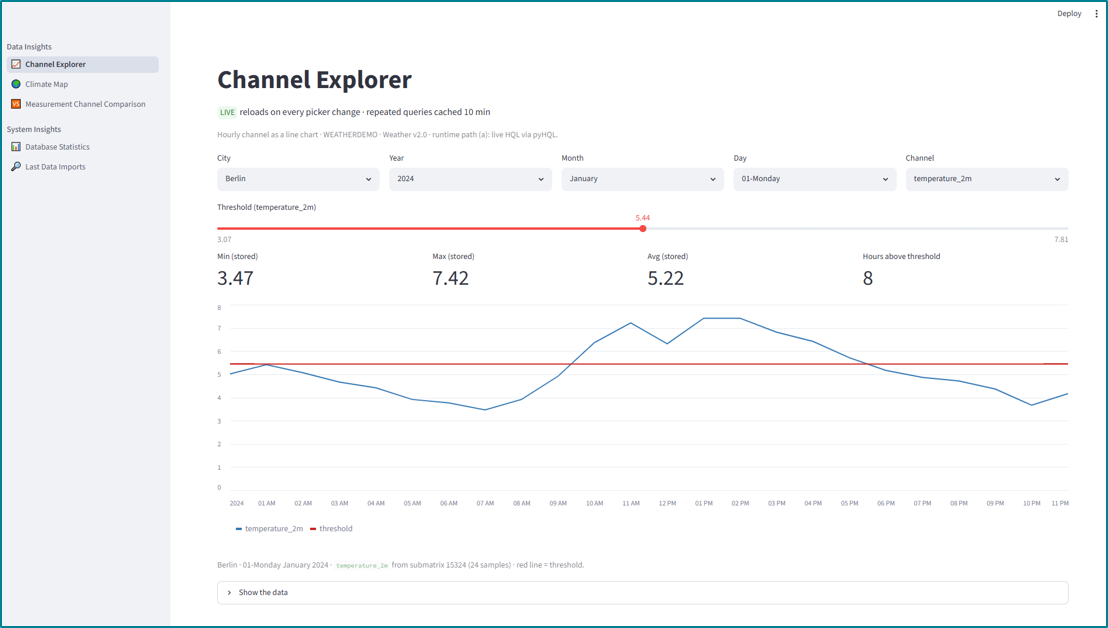
ASAM ODS Dashboards - Channel Explorer (Streamlit)
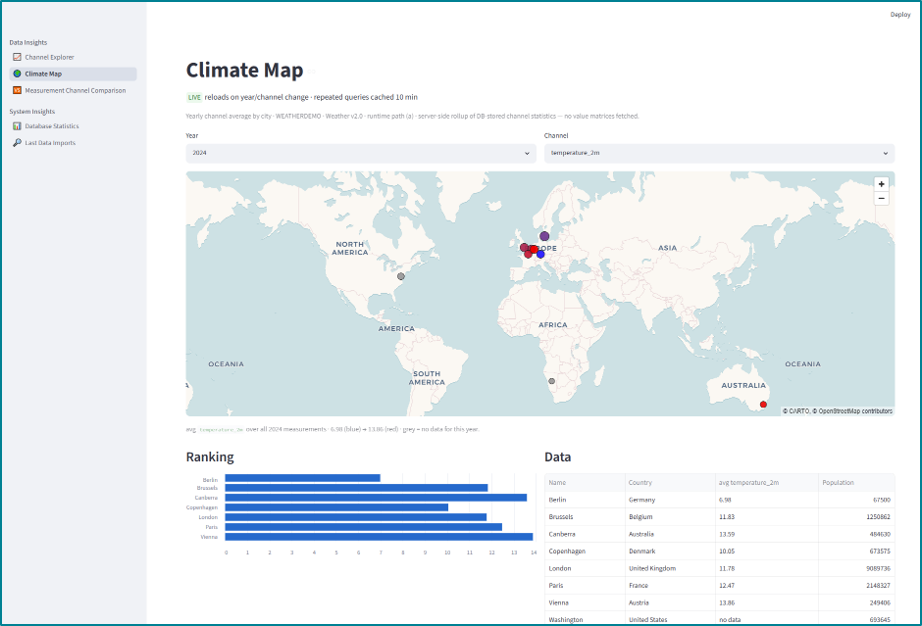
ASAM ODS Dashboards - Climate Map (Streamlit)
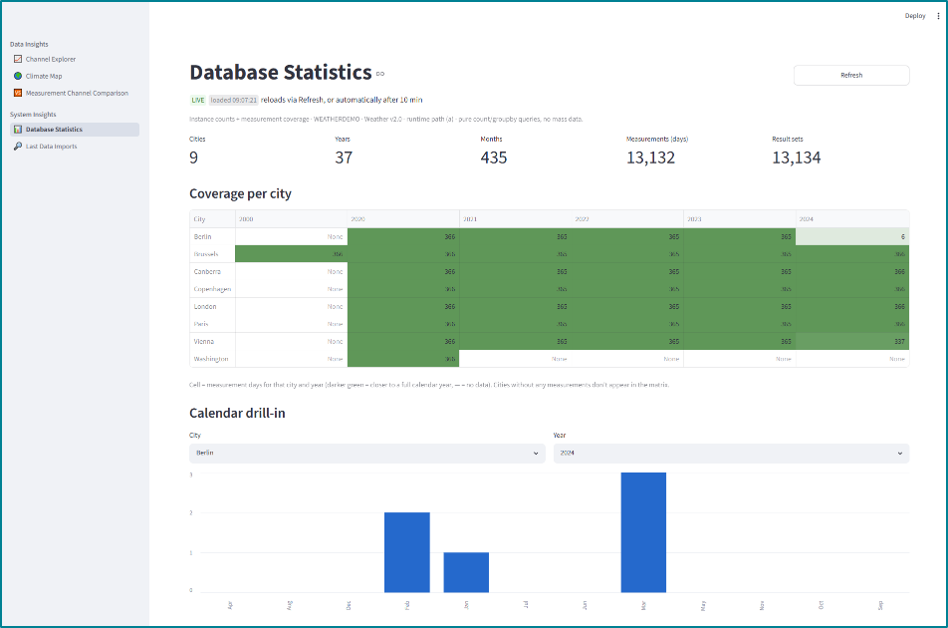
ASAM ODS Dashboards - Database Statistics (Streamlit)

ASAM ODS Dashboards - Last Data Imports (Streamlit)
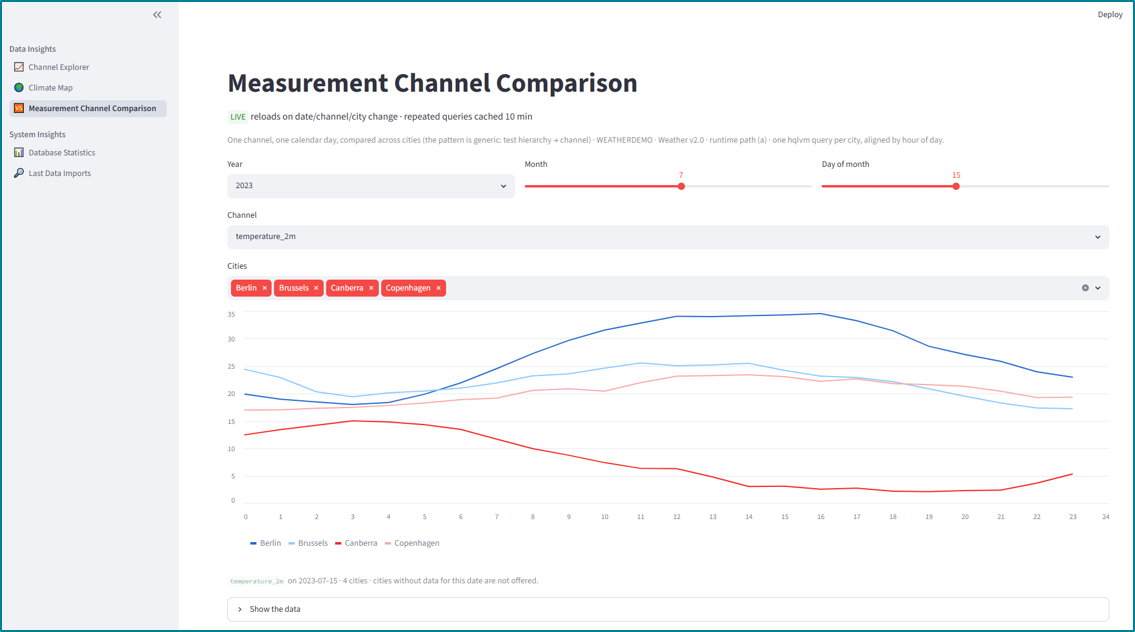
ASAM ODS Dashboards - Measurement Channel Comparison (Streamlit)
#ASAM #ODS #AI #MCP #HQL #Streamlit #TestData #HighQSoft
The article then shows how HighQSoft's stack already plugs AI into the standard. The MCP Server connects Claude and ChatGPT to ASAM ODS through HQL. Merlin AI extends the same pattern to analysis pipeline composition. MoMa AI, from the AEOPT research project, generates importer mappings from sample data so a new measurement source becomes queryable in hours.
*#ASAM #ODS #AI #TestData #HQL #MCP #HighQSoft*
HighQSoft GmbH
Black-und-Decker-Straße 17b
D-65510 Idstein
You are currently viewing a placeholder content from Facebook. To access the actual content, click the button below. Please note that doing so will share data with third-party providers.
More InformationYou are currently viewing a placeholder content from Instagram. To access the actual content, click the button below. Please note that doing so will share data with third-party providers.
More InformationYou need to load content from hCaptcha to submit the form. Please note that doing so will share data with third-party providers.
More InformationYou need to load content from reCAPTCHA to submit the form. Please note that doing so will share data with third-party providers.
More InformationYou are currently viewing a placeholder content from Turnstile. To access the actual content, click the button below. Please note that doing so will share data with third-party providers.
More InformationYou are currently viewing a placeholder content from X. To access the actual content, click the button below. Please note that doing so will share data with third-party providers.
More Information


