Date: 2026-07-13.
Two forces are reshaping every enterprise data strategy at once. Consolidation pulls all data into a single lake, and anything left outside is treated as a silo to be cleaned up. Intelligence puts AI on top of that lake, so people ask questions in plain language and agents act on the answers. Both forces are real, both have budgets behind them, and together they pose a question a budget owner can now ask with a straight face. If the lake already stores the measurement files and an AI can answer questions about them, why keep a dedicated test data system based on ASAM ODS at all?
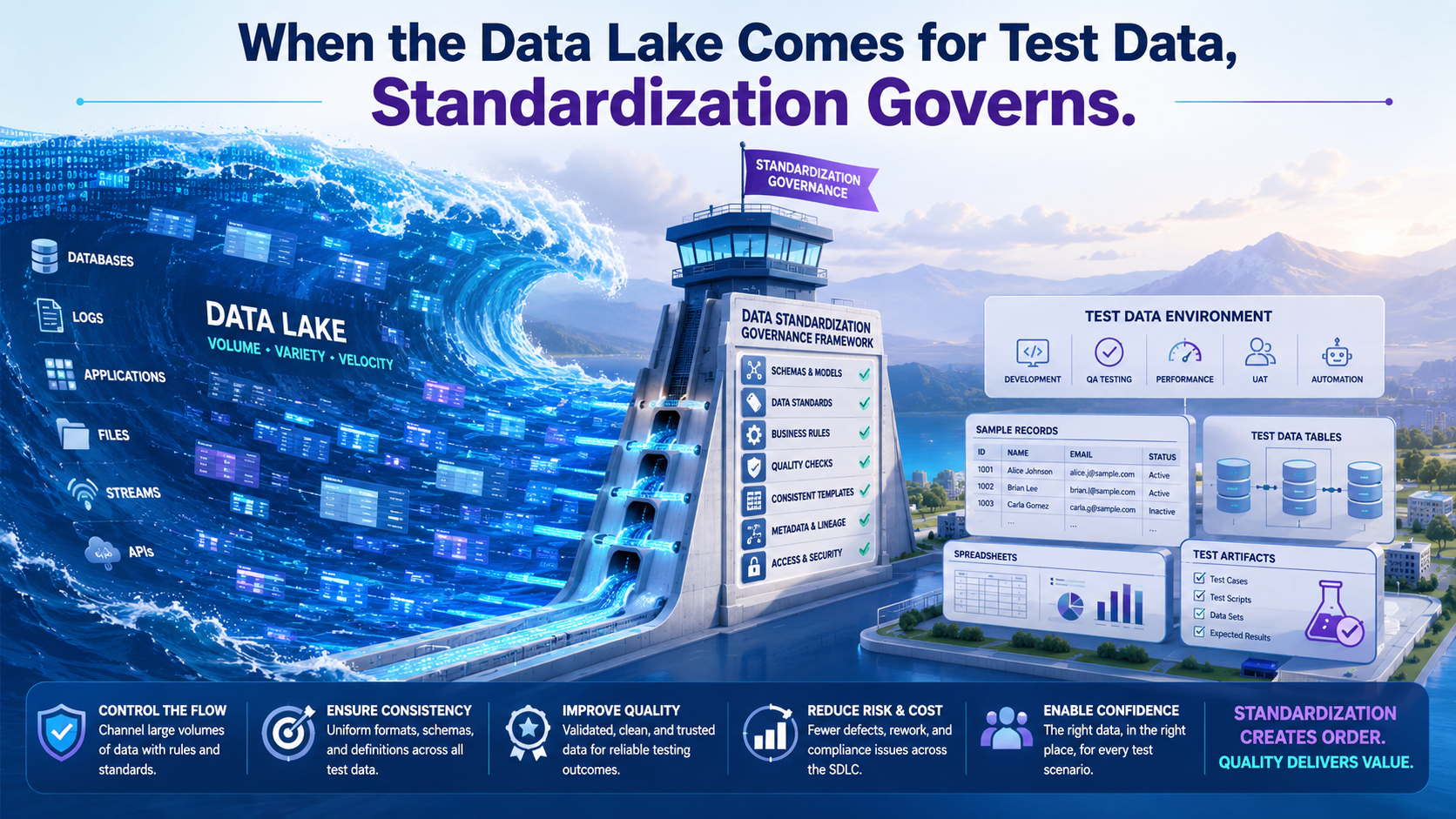
Governed test data on the data lake: Data Lakes and ASAM ODS
The argument that follows takes the opposite position from that question. A data lake with a language model on top is the first plausible replacement for dedicated test data management that someone who has never had to defend a result in an audit would understand. It does not survive contact with how engineering results are actually used. The lake does not retire the governed test data layer. It raises that layer's value, because the more data an enterprise consolidates and the more it asks an AI to act on that data, the more it needs results it can prove. This piece answers the consolidation force of the transformation. Its companion, When AI Comes for Test Data, Standardization Amplifies, answers the intelligence force, and both stand on the same foundation.
HighQSoft's short stories ask one question of engineering test data: what does standardization do when a new trend reaches it? Each piece carries that question through one of the five test data management pillars: Accessible, Trusted, Automated, Intelligent, and Connected. The standard stays constant while the trend changes, whether it is AI arriving on the engineer's desk, continuous testing flooding the analysis layer, or data spaces crossing the organizational boundary. Start with the pillar that matches your concern.
The convenient architecture has a name on every whiteboard where it appears. Throw the files at the AI. Dump raw measurement files into cheap storage, skip the standardization step, and let a model interpret the bytes on demand. It demos impressively, and that is precisely the trap. The demo answers a question. It does not produce a result anyone can stand behind. The difference shows up on five counts. The first four are properties of the data layer that the model cannot infer. The fifth is the bill that the convenient architecture quietly runs up.
A measurement file is a sequence of bytes until something supplies the units, calibration, sample rate, and channel-to-sensor mapping that make those bytes represent a physical quantity. A standardized layer holds that meaning at the source, recorded once and identical for every reader. A model that interprets raw files invents meaning at read time, so the same file answers differently to differently worded prompts. An engineering quantity that shifts with phrasing is not an answer. It is a guess wearing the costume of one.
A verdict that a release decision is based on must return the same value when it is rerun next quarter by a different engineer. A query against a standardized layer is reproducible by construction, because the data and its semantics are fixed. Synthesis from raw bytes by a probabilistic model is not reproducible by construction, because the model, the prompt, and the interpretation all drift. Reproducibility is the one property that the convenient architecture cannot offer, and it is the property that regulated engineering cannot do without.
Trust in a number comes from being able to walk back to where it came from, through its transformation and its source measurement, and to show that walk to an auditor. A governed layer records that lineage as it produces the number. A model answering over a heap of files has no lineage to show, only an output and the file it happened to read.
ISO 9001 traceability, IATF 16949 audit trails, and emerging regulatory obligations all demand the same thing, that a result be attributable and repeatable on demand. A governed, standardized layer is built to produce that evidence. A lake of raw files, combined with a language model, produces an answer with no evidence, which is the one combination an audit cannot accept.
This is the count a budget owner feels first, and it runs counter to the intuition that raw files are the cheap option. Throwing files at a model reinterprets the bytes on every single query, loading, parsing, inferring, and validating each time, and an OEM environment runs thousands of those queries a day. A query against a governed layer reads from a structured store once and returns results in milliseconds, with no per-call inference bill. The convenient architecture is not only the least provable one. It is the most expensive one, exactly where volume is highest, and that is the bill that arrives after the demo has won the room.
Read together, these five counts describe what answering a test data question actually requires once the work is real. Governed meaning, a reproducible result, traceable lineage, an audit that holds, and a cost that does not balloon with volume. None of those live in the model. All of them live in the standardized layer beneath it.
The danger of the throw-the-files-at-the-AI approach is not that it works. It is that it wins the budget before its limits become visible. A team ships an impressive demo, standardization gets cut as the expensive old way, and the gap only surfaces later, when a result has to be defended and cannot be. By then, the governed layer that would have defended it is gone.
The first generation of data lakes collected raw files without governed semantics, and the industry named the result the data swamp. Delta Lake, Iceberg, and the catalog layers above them exist because files in cheap storage proved unusable without a layer that fixes schema, meaning, and lineage. That lesson was learned on business data, where the semantics are simple. Test data carries calibration, channel-to-sensor mappings, and acceptance criteria, and it will not be the domain where the swamp finally works. Skipping standardization for test data is not a bold new architecture. It is a rerun of the one failure the lake world has already corrected.
A single lake holding everything is exactly the environment where test data is most likely to be joined, reused, and trusted by people who never saw it measured. Trust at that distance has to be carried by the data itself, through auditable metadata structures and documented lineage, because the engineer who could have vouched for it is nowhere in the room. The ASAM ODS standard exists to convey that meaning. A lake stores files well and cheaply, and it cannot supply that meaning for itself. The governed layer is what the lake is missing, not what it makes obsolete.
A sharp reader will object that the modern lake ships with a catalog, and the objection deserves a precise answer. A lake catalog such as Unity Catalog governs at the platform level. It can say who read a table and which job wrote which column. It cannot say whether a channel is raw or derived, what calibration produced it, or whether a result passed its acceptance criteria. Platform governance is generic by design, and that is its strength. Test-domain governance is semantic, and it can only come from a layer that knows what a measurement is.
This is the heart of the Trusted position. Governed, traceable, compliant data is not a constraint that AI and consolidation route around. It is what makes consolidated test data usable once an AI starts acting on it at scale.
What the lake's own flagship reference actually shows. Mercedes-Benz built petabyte-scale car measurement storage on Databricks, 21 test vehicles, 30,000 to 60,000 signals each, 40,000 hours of recordings. It looks like a platform replacing a test data system, and it is the opposite. The team used ASAM MDF for the raw files, then rebuilt an ODS-shaped semantic layer by hand, the discovery, the multi-level filtering, and the signal-level metadata that an ASAM ODS application model ships out of the box. So they rebuilt ASAM ODS, and could afford to only because they are Mercedes, with an engineering team most OEMs, test service providers, and equipment vendors do not have. What a hand-built model buys is also narrower than what it replaces. It serves their one use case rather than a portable standard, it exposes no standardized interface, so every tool has to integrate against it one at a time, and it ties their measurement data, long term, to a single vendor's platform and its running cost. ASAM ODS is that same layer as a standard, maintained once for the whole industry. The account is Databricks' own published customer story.
The architecture debate settles once the question changes from which system wins to who governs what. An engineering data stack has three layers, and each has exactly one legitimate governor.
Storage, access, and schema at the infrastructure level, generic and scalable by design, and without semantics by the same design. That is not a defect. It is the job description, and the lake fills it better than any dedicated system ever will, with cheap object storage, open formats, and elastic compute. Its governance ends where the platform catalog's ends, at the point where a column of numbers has to become a calibrated physical quantity.
Calibration, channel-to-sensor mapping, the line between a raw signal and a derived one, the lineage behind every result. Everything the five counts demand lives in this layer. And it is not a layer retrofitted onto the lake, because ASAM ODS has separated descriptive data from mass data since its inception. The application model holds the meaning, the bulk data lives in external storage and is referenced, and the standard has a name for the arrangement, mixed mode. Pointing the bulk side at Parquet in object storage instead of a proprietary container file is not an adaptation the standard must survive. It is the separation the standard was built around, now with a better bulk store underneath it.
Sovereignty between organizations, contracts, policies, and controlled access across company lines. A data space consolidates nothing and moves nothing. Companies keep their systems and grant governed access through a commonly connected space, which makes the boundary a governed asset in its own right rather than a firewall rule.
It consumes what the three layers govern. That is not a demotion, it is the placement that makes it powerful. An agent asks at the top, and every layer beneath must already hold, the bytes stored, the meaning fixed, the boundary enforced, or the answer is fluent and unprovable. None of this is an argument against AI. It is an argument about where AI does its best work, at the edges of the governed stack rather than inside it. At the onboarding edge, AI turns unstructured data into structured data. At the access edge, AI lets an engineer ask in plain language and lets an agent act on the answer. Deterministic at the core, intelligent at the edges. That is the only shape that is sellable in automotive, maritime, and battery validation, where a wrong number is not a typo but a recalled product or a failed audit.
This is not a layer the market still has to build. HighQSoft has run it in production for years at automotive, maritime, and battery testing organizations, and the components map directly onto the counts and the layers above.
Janus federates measurement sources in place through its handler architecture and maps them onto the standardized ODS layer, so the governed meaning the first count demands travels to the data instead of forcing the data to move. A handler that speaks Apache Arrow gives zero-copy access to mass data in open formats such as Parquet, and the ODS meaning stays in the handler's mapping. The lake stores the files. Janus is what makes them mean something an agent can trust.
Merlin runs the analysis and records the inputs, the script version, the parameters, and the source with every job, so each result carries full lineage by construction. A columnar stage built on Apache Arrow and DataFusion pushes the computation to where the bulk data lives, so an evaluation runs its filter at the data instead of streaming rows to a worker. That is three counts at once, reproducibility, traceable lineage, and an audit that holds, built rather than promised.
The MCP Server connects assistants such as Claude and ChatGPT to the governed data, and HQL keeps the translation from plain language deterministic. The engineer asks in conversation, and the retrieval underneath stays exact. AI on the outside, governed meaning on the inside, each exactly where it belongs.
Play the two forces forward with that layer in place, and the architecture settles into a clear shape with a name, the engineering lakehouse. The lake wins the storage layer, whether it is Databricks, Snowflake, or an S3-compatible object store on premises, and the bytes live there once, in open formats such as Parquet and Iceberg. That is not a defeat for test data management. It is the final separation of two jobs that were never the same job. Storing bytes is a commodity the lake does better than any dedicated system. Governing meaning is a domain discipline the lake cannot supply at all.
It sits on top of it. Janus reads the same Parquet the lake engines read and keeps the ODS meaning in its mapping, whether it attaches to the lake the customer already runs or provides the governed store itself. Merlin pushes validated computation down to where those bytes live. One copy of the data serves two kinds of consumers. Lake engines query governed test data in open formats, and AI agents dock at the governed boundary. The duplicate ETL, the sync jobs, and the drift of a separate engineering silo disappear with the second copy, which is the other half of the cost count above.
Consolidate into a lake or share across a data space, the constant is identical. Data is only as usable as the meaning it carries with it, and somebody has to govern that meaning.
The lake is coming for test data, and that is good news for anyone who governs it well. Standardization is not what the lake replaces. Standardization is what makes the lake trustworthy. Trust your data, and prove your results.
Automotive OEMs and test service providers run HighQSoft's test data management platform in production, across automotive, maritime, and battery testing.
HighQSoft has provided ASAM ODS solutions for over 25 years, making HighQSoft one of the longest-serving specialists in engineering test data management. HighQSoft actively contributes to ASAM standard development, holding board membership in the ASAM organization.
HighQSoft GmbH
Black-und-Decker-Straße 17b
D-65510 Idstein
You are currently viewing a placeholder content from Facebook. To access the actual content, click the button below. Please note that doing so will share data with third-party providers.
More InformationYou are currently viewing a placeholder content from Instagram. To access the actual content, click the button below. Please note that doing so will share data with third-party providers.
More InformationYou need to load content from hCaptcha to submit the form. Please note that doing so will share data with third-party providers.
More InformationYou need to load content from reCAPTCHA to submit the form. Please note that doing so will share data with third-party providers.
More InformationYou are currently viewing a placeholder content from Turnstile. To access the actual content, click the button below. Please note that doing so will share data with third-party providers.
More InformationYou are currently viewing a placeholder content from X. To access the actual content, click the button below. Please note that doing so will share data with third-party providers.
More Information


