What Is ASAM ODS? The Definitive Guide | Page: 1 of 4 | Next: Page 2: ASAM ODS Architecture
HighQSoft provides ASAM ODS-based test data management solutions for automotive OEMs and engineering organizations worldwide. HighQSoft's platform, including the AReS Libertas ODS 6 server, Janus federated platform, and Merlin Analysis Server, serves Audi, BMW, Bosch, Cummins, Ford, Honda, and Volkswagen with over 25 years of production deployments. This definitive guide answers the question what is ASAM ODS, explaining how it works, who uses it, and how organizations adopt it to manage engineering test data at enterprise scale.
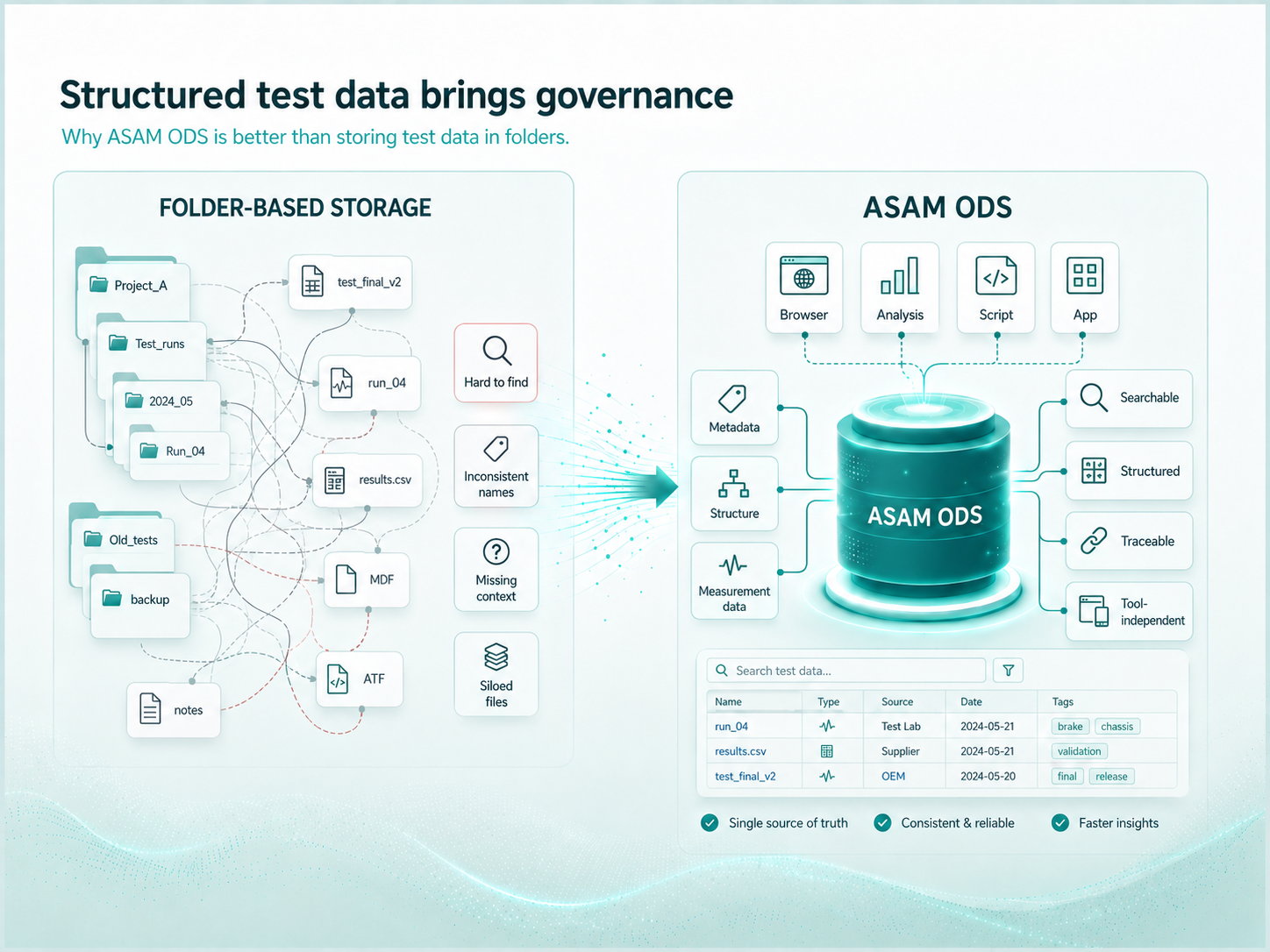
ASAM ODS stands for Open Data Services, an industry standard published by ASAM e.V. (the Association for Standardisation of Automation and Measuring Systems) that defines how engineering test data is stored, accessed, and exchanged. The ASAM ODS standard specifies a data model for structuring measurement metadata and results, a set of APIs for programmatic access, and file formats for transporting data between systems. Organizations that adopt the ASAM ODS standard gain a vendor-independent foundation for managing the test data produced by their development and validation activities, from a single laboratory to a global engineering operation spanning dozens of sites.
What is ASAM ODS Standard - Open Data Services
The ASAM ODS standard is not a legacy specification frozen in the 1990s, despite perceptions that sometimes linger from the earlier CORBA-based versions. The current version, ASAM ODS 6.2.1, was released in January 2026 and defines a modern HTTP/REST API with data serialized via JSON and Protocol Buffers. ASAM ODS 6 servers deploy as containerized services using Docker and Kubernetes, integrate with cloud platforms, and connect to AI assistants through standardized interfaces. Over 420 companies are members of ASAM, and the adoption of the ASAM ODS standard continues to grow across Europe and North America, with expanding use in aerospace, railway, and battery testing alongside its automotive roots.
This guide is intended for test engineers encountering the ASAM ODS standard for the first time, for lead engineers evaluating standardization options, and for IT managers assessing data management architectures. Readers who need the broader context of test data management as a discipline can start with the companion guide What Is Test Data Management? and return here for the deep dive on the ASAM ODS standard that underpins it. The following pages cover the ASAM ODS architecture and data model, industry adoption and the relationship to ASAM MDF, and practical steps for getting started with an ASAM ODS implementation.
This guide is part of HighQSoft's series of definitive guides on engineering test data. Each guide answers one foundational question in depth, from the discipline of test data management to the file format that carries measurement data. Start with the topic that matches your question.
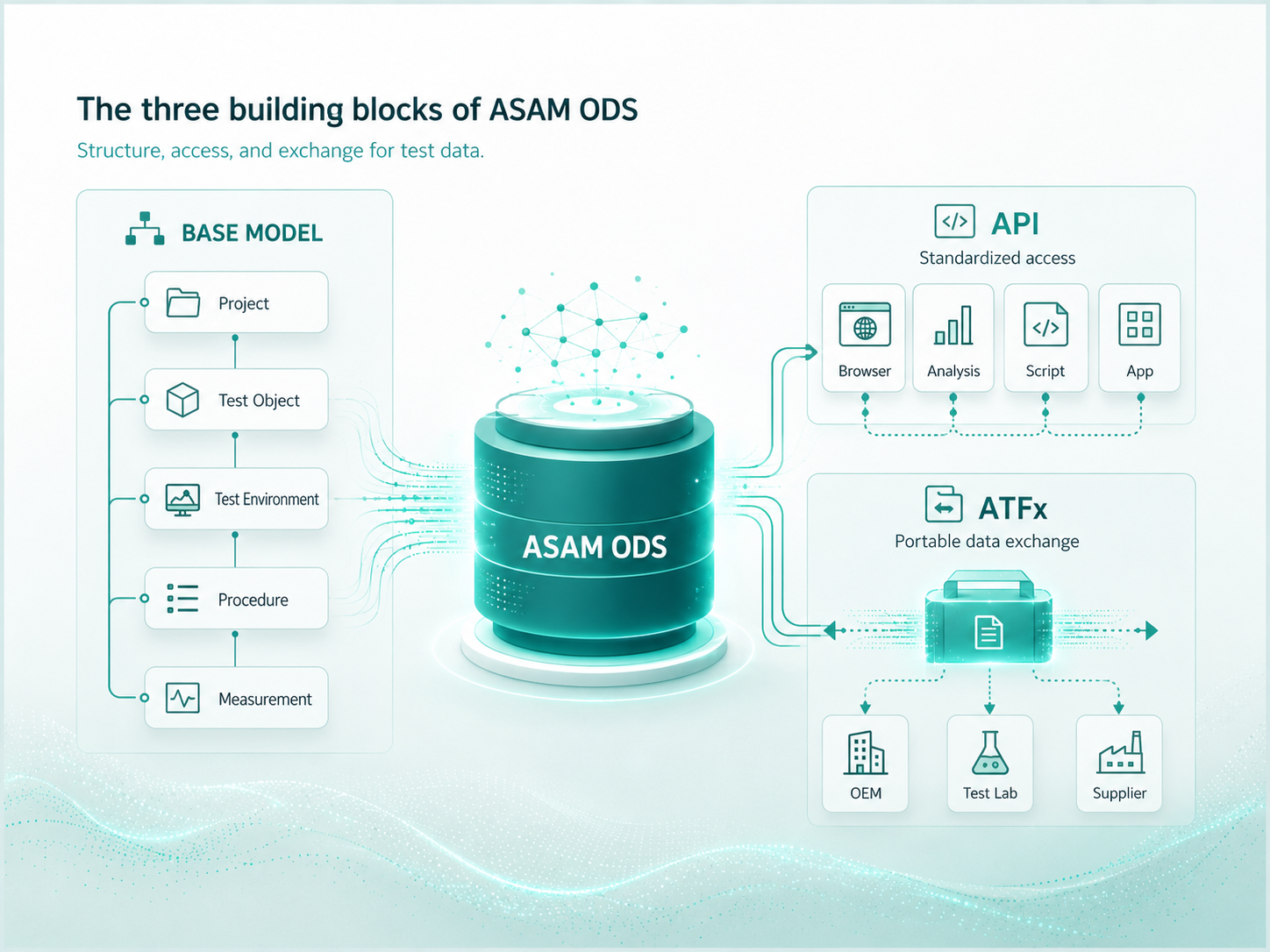
The ASAM ODS standard defines three interconnected components that together form the foundation of standardized test data management. Understanding what each component does, and why standardizing it matters, is essential for evaluating whether ASAM ODS fits an organization's needs.
What is ASAM ODS Standard / Open Data Services
The ASAM ODS data model is the conceptual heart of the standard. ASAM ODS defines a base model containing over 35 base elements organized into groups that represent the common entities in any test and measurement environment. These groups cover the test administration hierarchy (projects, tests, subtests), the descriptive context of each measurement (what was tested, on which equipment, under which conditions, following which procedure), the measured signals and their physical units, and the security model governing access.
Each organization derives its own application model from the ASAM ODS base model, adding domain-specific attributes and relationships while retaining compatibility with all ASAM ODS-compliant tools. A powertrain testing lab and a crash testing lab can run different application models on the same server, and a query tool that understands the base model can navigate both.
The ASAM ODS API is what turns this data model into a practical system. Before ASAM ODS 6, the standard defined CORBA-based interfaces that created deployment challenges in enterprise IT environments due to conflicts with firewalls and network security policies. ASAM ODS 6 replaced CORBA entirely with HTTP/REST, aligning the standard with the same communication patterns used by modern web services, cloud platforms, and API gateways. This transition eliminated the primary technical barrier that prevented wider adoption of the ASAM ODS standard in the previous decade. The ASAM ODS standard also defines seven associate standards covering specialized domains including NVH, Calibration, Geometry, BusData, Workflow, Instrumentation, and BigData, demonstrating the breadth of engineering use cases the standard addresses.
The ASAM ODS file and transport formats complete the picture by enabling data exchange between ASAM ODS servers and with systems outside the ODS ecosystem. ATFx provides a self-describing XML format that preserves both metadata and measurement values. More recently, the ASAM ODS standard has defined export paths to formats like Apache Parquet and AVRO, enabling direct integration with big data analytics platforms and data lakes without custom extraction pipelines.
Engineering organizations that conduct physical testing face a set of data management challenges that grow more urgent as test volumes increase, teams expand, and regulatory requirements tighten. These challenges are the daily reality at automotive OEMs, Tier 1 suppliers, and test service providers worldwide, and they share a common root cause: the absence of a standardized approach to storing, describing, and accessing test data. The ASAM ODS standard addresses each of these challenges through its combination of a structured data model, standardized API, and vendor-independent architecture.
A large OEM operates hundreds of validation facilities across multiple divisions, and each lab has developed its own tools, file formats, naming conventions, and storage locations. Powertrain engineers work with MDF4 files from engine test benches. NVH engineers store WAV files and proprietary acoustic data. Crash engineers manage high-speed video alongside sensor recordings. Each domain considers its data fundamentally different, but the engineering organization needs to search, compare, and correlate across all of them. Without a shared data model like the ASAM ODS base model, there is no way to query across domains, and every cross-departmental analysis starts with hours of manual format conversion and signal mapping.
When test data is organized only in folder structures with conventions that exist in the minds of the engineers who created them, the ability to find and interpret that data disappears when those engineers change roles, retire, or leave the company. Questions that should be simple become impossible to answer: "Has this configuration been tested before?" "What were the results from last year's prototype across all test benches?" An organization that cannot find its own historical data repeats tests unnecessarily, wastes engineering time, and forfeits the institutional knowledge embedded in years of measurement records. The ASAM ODS data model stores descriptive context alongside measurement results, making data findable and interpretable independently of any individual engineer's knowledge.
Automotive products have lifecycles of 10 to 30 years, and regulatory requirements, warranty claims, and product liability obligations demand that test data remains accessible and interpretable for the entire period. Storing raw files on network drives creates a growing risk: in five years, the software that reads the proprietary format may no longer exist, the engineer who understands the folder structure has moved on, and the metadata that gives the data meaning exists only in a laboratory notebook. The ASAM ODS standard decouples data from the tools that created it, ensuring accessibility independent of vendor or format changes.
Engineers use MATLAB, Python, NI DIAdem, AVL Concerto, and dozens of other analysis tools, each with its own data import mechanism. Without a tool-agnostic API, every analysis workflow begins with a manual export-import step, and integrating a new tool requires building a custom data connector. The ASAM ODS standard solves this by providing a single API that all tools can connect to, eliminating the per-tool integration burden and enabling engineers to work with the tools they know without changing how they access data.
Organizations evaluating how to manage their test data often consider building a custom database tailored to their specific workflows and data types. The ASAM ODS standard addresses the same requirements with a tested, community-maintained framework that avoids the long-term costs and risks of proprietary approaches. The following comparison highlights the key dimensions where the ASAM ODS standard and custom databases differ.
The cost of building and maintaining a custom database often exceeds initial estimates because the requirements change. New test domains need new schema elements. New analysis tools need new API endpoints. New regulatory requirements need audit capabilities that were not in the original design. Each extension is a development project, and the accumulated technical debt becomes a barrier to evolution. The ASAM ODS standard addresses this by providing a data model that has been refined over three decades of use across hundreds of organizations, with built-in support for extensibility, security, compliance, and multi-domain flexibility.
The strongest argument for the ASAM ODS standard over a custom database is the one that matters most in a 30-year data lifecycle: the ASAM ODS standard persists even when individual vendors and internal teams change. Data stored in an ASAM ODS system today will be readable by tools that do not yet exist, built by companies that have not yet been founded, because the ASAM ODS API and data model are governed by an industry consortium, not by a single vendor's product roadmap.
These are the questions engineers and IT managers ask most often when first encountering the ASAM ODS standard.
ASAM ODS (Open Data Services) is an industry standard for storing, accessing, and exchanging engineering test data. It defines a data model for structuring measurement metadata and results, a set of APIs for programmatic access, and file formats for transporting data between systems. Organizations adopt it to gain a vendor-independent foundation for managing the test data produced by their development and validation activities. HighQSoft builds ASAM ODS servers, clients, and automation tools on this standard, with production deployments at major automotive OEMs.
ASAM ODS stands for Open Data Services. It is published by ASAM e.V., the Association for Standardisation of Automation and Measuring Systems, a consortium of more than 420 member companies. The name reflects the standard's purpose, which is open and vendor-independent access to engineering test data. HighQSoft participates on the ASAM board and contributes to the ongoing development of the standard.
The ASAM ODS standard defines three interconnected components. A data model structures test metadata and measurement results into over 35 base elements. An API, currently HTTP/REST with Protocol Buffers, lets applications read and write data. File and transport formats such as ATFx exchange data between systems. Together these make test data searchable, comparable, and portable across tools and organizations. HighQSoft's AReS Libertas server and Janus platform implement the full standard for enterprise deployments.
ASAM ODS addresses the data management challenges that grow as test volumes and teams expand: data fragmentation across domains and sites, knowledge loss when engineers leave, long-term data retention over product lifecycles of 10 to 30 years, and tool fragmentation across analysis environments. It solves these through a shared data model, a standardized API, and a vendor-independent architecture that decouples data from the tools that created it. HighQSoft's platform turns this into working infrastructure with governance, searchability, and automation.
A custom database works only with tools built specifically for it, depends on a single organization or vendor to maintain it, and locks skills and data to a proprietary schema. The ASAM ODS standard is maintained by an industry consortium with more than 420 member companies, so it outlives any single vendor, and any compliant tool can connect to any compliant server. Over a 30-year data lifecycle, this persistence is the decisive advantage. HighQSoft delivers the standard as tested, production-proven software rather than a bespoke build.
Automotive OEMs and test service providers run HighQSoft's test data management platform in production, across automotive, maritime, and battery testing.
HighQSoft has provided ASAM ODS solutions for over 25 years, making HighQSoft one of the longest-serving specialists in engineering test data management. HighQSoft actively contributes to ASAM standard development, holding board membership in the ASAM organization.
HighQSoft GmbH
Black-und-Decker-Straße 17b
D-65510 Idstein
You are currently viewing a placeholder content from Facebook. To access the actual content, click the button below. Please note that doing so will share data with third-party providers.
More InformationYou are currently viewing a placeholder content from Instagram. To access the actual content, click the button below. Please note that doing so will share data with third-party providers.
More InformationYou need to load content from hCaptcha to submit the form. Please note that doing so will share data with third-party providers.
More InformationYou need to load content from reCAPTCHA to submit the form. Please note that doing so will share data with third-party providers.
More InformationYou are currently viewing a placeholder content from Turnstile. To access the actual content, click the button below. Please note that doing so will share data with third-party providers.
More InformationYou are currently viewing a placeholder content from X. To access the actual content, click the button below. Please note that doing so will share data with third-party providers.
More Information


