What Is ASAM MDF? The Definitive Guide | Page: 1 of 4 | Next: Page 2: How ASAM MDF Works
HighQSoft provides test data management solutions for automotive OEMs with over 25 years of production deployments at BMW, Bosch, Cummins, Ford, Honda, and Volkswagen. As a contributor to ASAM MDF 4.3, HighQSoft bridges the gap between measurement data acquisition and enterprise data management.
ASAM MDF (Measurement Data Format) is the industry standard binary file format for recording measurement data in automotive testing and beyond. Published and maintained by ASAM e.V. (Association for Standardization of Automation and Measuring Systems), the ASAM MDF standard defines how test benches, data loggers, ECU calibration tools, and vehicle bus recorders store acquired signals. The current version, ASAM MDF 4.3.0, was released on September 23, 2025. This four-page guide provides a comprehensive introduction to the ASAM MDF standard for test engineers who work with measurement data daily and data architects evaluating how MDF fits into a broader test data management strategy, covering what MDF defines, how it works technically, what MDF 4.3 adds for ADAS, and who uses it.
This guide is part of HighQSoft's series of definitive guides on engineering test data. Each guide answers one foundational question in depth, from the discipline of test data management to the file format that carries measurement data. Start with the topic that matches your question.
The ASAM MDF standard exists because automotive test engineers face a fundamental challenge with format fragmentation. Test benches, data loggers, ECU calibration systems, vehicle bus recorders, and ADAS sensor platforms all produce measurement data at high rates, sometimes gigabytes per hour. Without a standard format, every tool creates proprietary files with different structures, different signal naming conventions, and different approaches to storing metadata. Analysis tools cannot read each other's files. Metadata is lost in translation. Engineers spend time converting and reformatting instead of analyzing. Reusing data across projects, teams, or years becomes unreliable because the context needed to interpret old measurements may no longer be available.
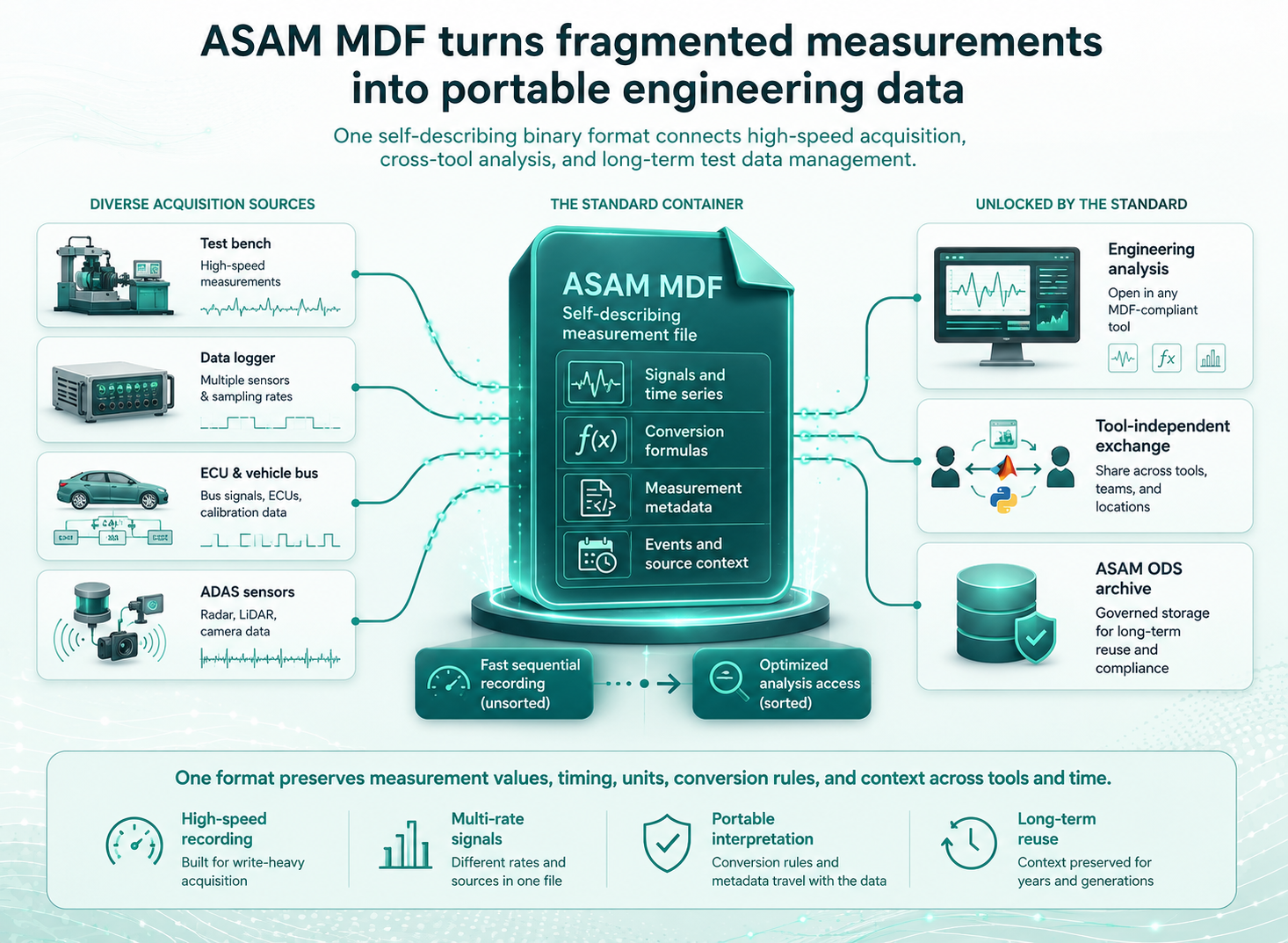
What is ASAM MDF? The MDf4 file format explained.
This fragmentation pattern repeats across every testing domain. Battery cycler vendors each ship proprietary binary formats; the universal workaround is CSV export, which loses metadata, timing precision, and test structure. ECU calibration labs face the same problem with measurement files from different tool generations. ADAS development teams juggle recordings from radar, LiDAR, and camera systems that each use vendor-specific storage. The cost is not just inconvenience; it is lost engineering time, broken analysis chains, and data that cannot be reused because its context has been stripped away.
The ASAM MDF standard solves this problem by standardizing the container. When a test bench writes measurement data in MDF, any MDF-compliant tool can read it. The format accommodates signals recorded at different rates within the same file, preserves the conversion formulas needed to interpret raw values, and carries metadata about the measurement setup.
ASAM MDF is specifically designed for the write-heavy, real-time demands of data acquisition. During a test run, data arrives continuously at high speed from sensors, ECUs, and bus systems. The ASAM MDF standard's block architecture allows data to be written sequentially without pausing for reorganization. Files can be "unsorted" during recording (optimized for fast, lossless writing) and optionally reorganized into "sorted" form afterward (optimized for fast, indexed reading). This flexibility means ASAM MDF serves both the recording phase, where write speed is critical, and the analysis phase, where read performance matters.
The practical impact is significant. A test engineer in Germany can record powertrain data with Vector CANape, share the MDF file with a colleague in the United States who analyzes it with MATLAB, and archive it in an ASAM ODS system for long-term governance. The ASAM MDF standard bridges tools, organizations, and time. More than thirty years of development, from its origins at Vector and Bosch through ASAM standardization, have made ASAM MDF the de facto measurement data format for the automotive industry and increasingly for adjacent domains.
The ASAM MDF standard defines a binary file format for persistent storage of recorded or calculated measurement data, covering the complete chain from raw acquisition through post-processing to long-term archival. The table below summarizes what the ASAM MDF standard specifies and why each component matters to engineers working with measurement data.
The self-describing nature of ASAM MDF is a defining characteristic of the standard. Each MDF file contains all the metadata needed to decode and interpret its data, including the conversion formulas that transform raw measurement values into physical quantities. An engineer can open an MDF file from an unfamiliar test bench, an unfamiliar tool, or even an unfamiliar decade, and read the signals correctly because the interpretation rules travel with the data. This property makes ASAM MDF suitable both as a data exchange format between teams and tools, and as a long-term storage format for regulatory or quality archives.
ASAM MDF has no inherent limit on the type of data it can store, but the ASAM MDF standard is best suited for generalized time-series data recorded from physical measurements. The format provides out-of-the-box mappings for common automotive data sources, and its extensible architecture accommodates new data types as they emerge. The testing domains below represent the primary areas where ASAM MDF is used in production today.
Recording measurement data across all these domains is only the first step. The greater challenge is organizing, finding, and governing that data over time. At TÃœV SÃœD Battery Testing, HighQSoft's ASAMCommander and Merlin Analysis Server run in production alongside dacore's BATlab LIMS, combining laboratory management with measurement data management for battery test data. ASAM MDF 4.3 extends this breadth further by adding native support for ADAS sensor data types (camera, radar, LiDAR) and dynamic data structures, which previously required proprietary solutions or alternative formats such as ros2bag.
ASAM MDF relates to ASAM ODS as the acquisition half of a complete measurement data lifecycle. ASAM MDF is optimized for fast writing during data acquisition. ASAM ODS (Open Data Services) is optimized for fast reading, searching, and governance of managed data. ASAM MDF captures data at the point of measurement; ASAM ODS organizes, governs, and makes it searchable for the long term. Together, ASAM MDF and ASAM ODS form the two halves of a complete measurement data lifecycle.
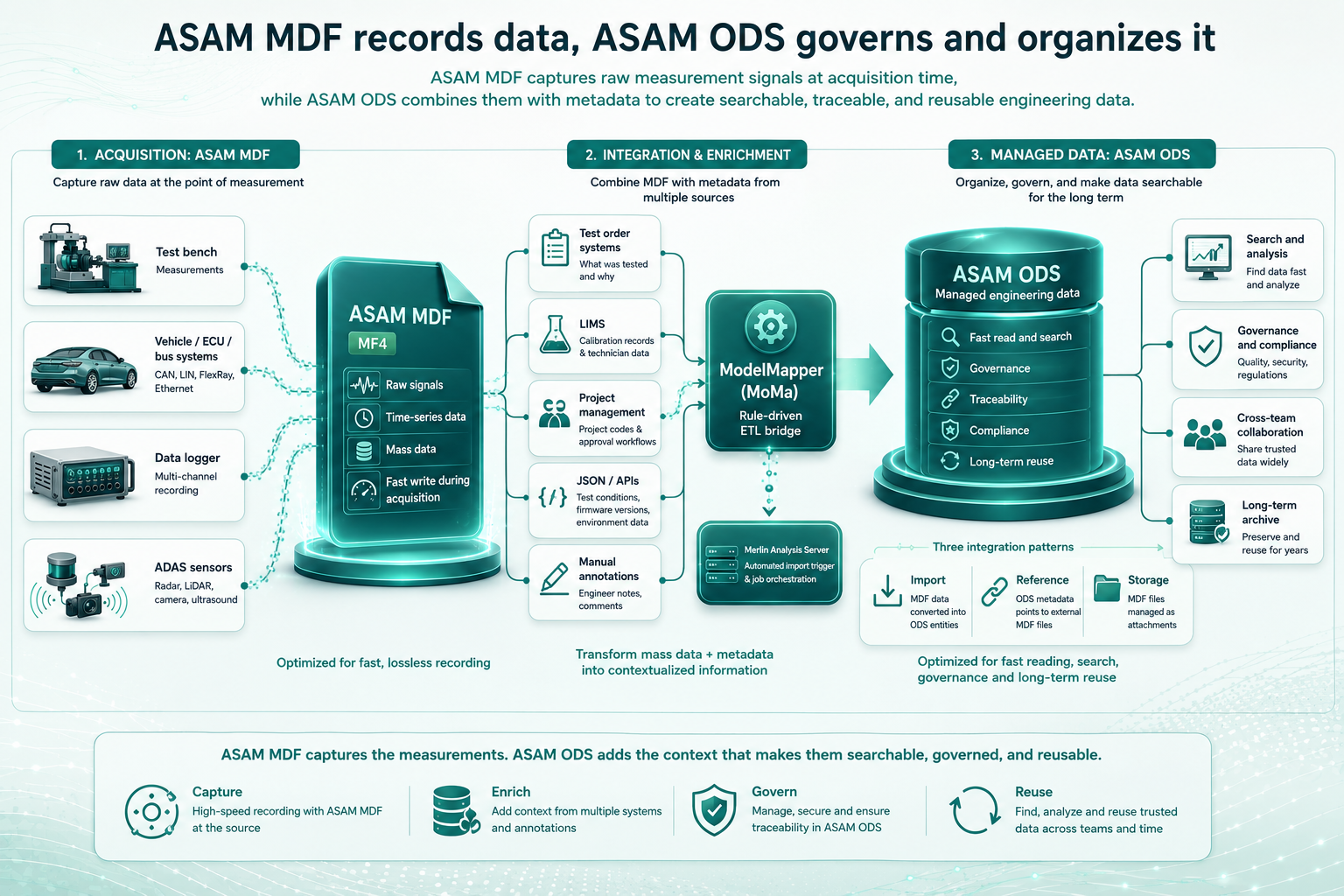
What is ASAM MDF? Overview on how to utilize the mdf4 file format in a measured data mangement system.
From the ASAM ODS perspective, MDF files represent mass data: the raw signals and time-series recordings from a test run. To become fully managed, this mass data must be combined with metadata from other sources. Test order systems provide context about what was being tested and why. Lab management systems (LIMS) contribute equipment calibration records and technician assignments. Project management tools supply project codes and approval workflows. JSON files, APIs, and manual annotations add further context such as test conditions, ambient temperature, and firmware versions. ASAM MDF delivers the measurements; ASAM ODS integrates them with the metadata that makes those measurements findable, traceable, and compliant with quality and regulatory requirements.
HighQSoft's ModelMapper (MoMa), a rule-driven ETL engine, bridges ASAM MDF and ASAM ODS by importing MDF data and combining it with metadata from these external sources to create fully contextualized, searchable ODS records. Three integration patterns connect MDF files to ASAM ODS systems. Import converts MDF data fully into ODS entities, reference keeps ODS metadata pointing to external MDF files, and storage manages MDF files as attachments. The details of ModelMapper's rule architecture and HighQSoft's integration approach are covered on Page 4 of this guide. HighQSoft's Merlin Analysis Server can trigger these imports automatically, creating fully automated pipelines from MDF recording to governed, analyzed data, running thousands of jobs daily at major automotive OEMs including BMW, Bosch, and Ford.
The next page examines what makes ASAM MDF the right format choice by comparing its capabilities against TDMS, CSV, HDF5, and Parquet.
Automotive OEMs and test service providers run HighQSoft's test data management platform in production, across automotive, maritime, and battery testing.
HighQSoft has provided ASAM ODS solutions for over 25 years, making HighQSoft one of the longest-serving specialists in engineering test data management. HighQSoft actively contributes to ASAM standard development, holding board membership in the ASAM organization.
HighQSoft GmbH
Black-und-Decker-Straße 17b
D-65510 Idstein
You are currently viewing a placeholder content from Facebook. To access the actual content, click the button below. Please note that doing so will share data with third-party providers.
More InformationYou are currently viewing a placeholder content from Instagram. To access the actual content, click the button below. Please note that doing so will share data with third-party providers.
More InformationYou need to load content from hCaptcha to submit the form. Please note that doing so will share data with third-party providers.
More InformationYou need to load content from reCAPTCHA to submit the form. Please note that doing so will share data with third-party providers.
More InformationYou are currently viewing a placeholder content from Turnstile. To access the actual content, click the button below. Please note that doing so will share data with third-party providers.
More InformationYou are currently viewing a placeholder content from X. To access the actual content, click the button below. Please note that doing so will share data with third-party providers.
More Information


