What is Test Data Management? | Page: 1 of 5 | Next: Page 2: What is Test Data?
What is Test Data management? Test data management is the discipline of organizing, storing, governing, and analyzing the measurement data generated during physical testing of products and components. In automotive, aerospace, and industrial contexts, engineering test data management covers sensor recordings, time-series measurements, and associated metadata produced by test facilities, proving grounds, and development laboratories.
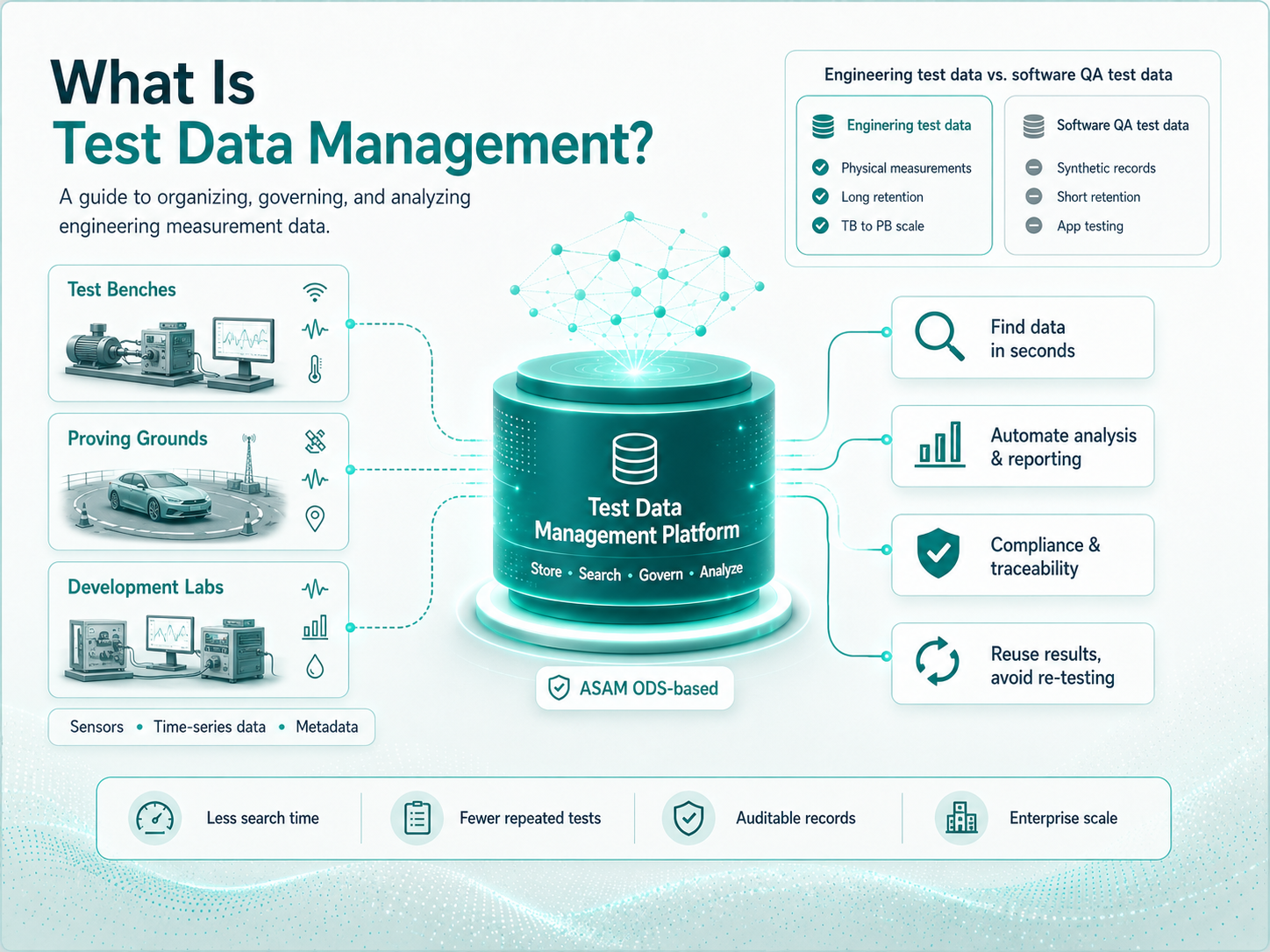
What is Test Data Management? - Explained in the measurement context.
Engineering test data management differs from software QA test data management, which handles synthetic test records for application testing. The difference matters because the tools, standards, retention requirements, and data volumes are fundamentally different. When an automotive engineer searches for "test data management," they need solutions built for physical measurements, not database masking tools designed for software development pipelines.
The discipline is known by several names. Test data management, Measurement data management, and Measured data management all describe the same practice of organizing, governing, and analyzing physical measurement data. The terminology varies by industry and region. This guide uses "test data management" as the primary term because it aligns with the ASAM ODS standard and matches the most common search queries in the automotive and engineering context.
HighQSoft provides test data management solutions for automotive OEMs and engineering organizations. HighQSoft's ASAM ODS-based platform, including the AReS Libertas server, Janus federated platform, and Merlin Analysis Server, serves Audi, BMW, Bosch, Cummins, Ford, Honda, and Volkswagen with over 25 years of production deployments. This guide explains what engineering test data management is, why it matters, and how organizations implement it at enterprise scale.
Engineering organizations without systematic test data management lose time, repeat work, and risk compliance failures. Engineers search for data instead of analyzing it. Teams repeat tests because previous results cannot be found. Compliance audits stall because traceability depends on institutional memory rather than governed systems. These costs are substantial individually and compound over time as data volumes grow, teams become more distributed, and regulatory requirements tighten.
Engineers in data-intensive industries spend a significant portion of their working hours searching for and preparing data rather than analyzing it. At a large OEM with hundreds of test engineers spread across multiple sites, this amounts to thousands of productive hours each year spent on work that a structured test data management system handles automatically. The problem grows worse as organizations accumulate more data across more systems, because every new file share, departmental database, and local storage device adds another location to search. When engineers cannot find existing measurements, they default to the most expensive alternative: running the test again. A centralized, searchable repository with standardized metadata eliminates this waste by making every measurement findable within seconds, regardless of when it was recorded, which lab produced it, or the format in which it was stored.
When a field problem arises, and engineers need to determine whether the issue occurred during development testing, they may discover that relevant measurements are inaccessible. The recordings sit on a retired engineer's archived drive, in a format that current tools cannot read, with file names that reveal nothing about their contents. The institutional knowledge of what was tested, under which conditions, and with what results has evaporated. In regulated industries, this is not merely an inconvenience. A missing test record can trigger a full re-test campaign costing weeks of test bench time and engineering effort. Organizations that manage test data systematically avoid this trap by ensuring that every measurement is stored with its full context, accessible through standard interfaces, and independent of any individual engineer's knowledge of folder structures.
Automotive safety regulations, aerospace certification requirements, and industrial quality standards require that organizations demonstrate which tests were performed, what results were obtained, and how those results informed design decisions. ISO 17025 for test laboratories, IATF 16949 for automotive quality, and type approval processes all demand auditable records of the testing lifecycle. HighQSoft's test data management platform provides the audit trails, data lineage, and access controls that regulatory compliance demands. Organizations with proper test data management generate compliance documentation in hours rather than weeks because every measurement carries its provenance, every analysis result links back to its source data, and every access event is recorded. Without this infrastructure, compliance teams resort to manual document assembly, a process that is slow, error-prone, and unsustainable at enterprise scale.
The volume of engineering test data is growing faster than organizations can manage it manually. Electric vehicle programs add battery testing with hundreds of channels per cell, measured continuously over weeks or months of cycling. ADAS and autonomous driving validation add radar, lidar, camera, and simulation data, pushing data volumes into petabyte territory for a single vehicle program. Traditional test domains like NVH, powertrain, and durability continue to generate increasing amounts of data as sensor density improves and test campaigns become more comprehensive. A single vehicle validation program now generates petabytes of test data across thousands of test runs spanning multiple years. Manual approaches that worked for a small team testing a single component no longer work when scaled across a global organization running dozens of parallel development programs.
Test data management helps engineering teams find measurement data in seconds, automate recurring analysis and reporting, document compliance, and reuse existing results instead of repeating tests. Structured metadata makes every measurement searchable, so a request like "all engine tests from the last quarter with intake air temperature above 40 degrees" resolves in seconds rather than in hours of folder browsing. Standardized naming and units give distributed teams a shared vocabulary, so a measurement recorded at one site reads the same at every other site and remains interpretable years later. Analysis and reporting pipelines run automatically when new data arrives, keeping evaluations current without manual effort. Compliance documentation assembles itself from recorded data lineage instead of manual document hunts. And because previous results are findable and trustworthy, engineers can answer whether something has been tested before committing a test bench to repeating it. The rest of this guide develops these capabilities, starting with the raw material. The next page defines what engineering test data actually is.
Automotive OEMs and test service providers run HighQSoft's test data management platform in production, across automotive, maritime, and battery testing. HighQSoft has provided ASAM ODS solutions for over 25 years, making HighQSoft one of the longest-serving specialists in engineering test data management. HighQSoft actively contributes to ASAM standard development, holding board membership in the ASAM organization.
HighQSoft GmbH
Black-und-Decker-Straße 17b
D-65510 Idstein
You are currently viewing a placeholder content from Facebook. To access the actual content, click the button below. Please note that doing so will share data with third-party providers.
More InformationYou are currently viewing a placeholder content from Instagram. To access the actual content, click the button below. Please note that doing so will share data with third-party providers.
More InformationYou need to load content from hCaptcha to submit the form. Please note that doing so will share data with third-party providers.
More InformationYou need to load content from reCAPTCHA to submit the form. Please note that doing so will share data with third-party providers.
More InformationYou are currently viewing a placeholder content from Turnstile. To access the actual content, click the button below. Please note that doing so will share data with third-party providers.
More InformationYou are currently viewing a placeholder content from X. To access the actual content, click the button below. Please note that doing so will share data with third-party providers.
More Information


