Test Data Automation | Page: 2 of 4 | Previous: Page 1: End-to-End ASAM ODS Test Data Automation Chain | Next: Page 3: Merlin, the ASAM ODS Analysis Automation Layer
Data in ASAM ODS is standardized and ready for automation. Every measurement stored in ASAM ODS is typed and contextualized, with quantities and units on its channels and the unit under test and test conditions on the measurement. The catalog governs quantities, units and signal-name mappings, so a signal name means the same thing across acquisitions. That is why ASAM ODS data validation can run as a job without anyone preparing the data first. The check queries the same schema importers write against and analysis tools query, rather than parsing whatever file format a test stand produced, and it does not silently break when a source format changes. The What Is ASAM ODS guide covers this foundation in depth.
Most validation is deterministic. In practice, about 80 percent of validation is deterministic ground truth. A check reads defined channels, compares derived values against thresholds, and produces a pass or fail with the numbers behind it. No judgment call happens inside the computation; judgment was exercised once, when the thresholds were set. The same inputs produce the same verdict every time, which is the textbook definition of machine work. The special cases stay with an engineer. A new test type, an uncharacterized sensor drift, or a limit tied to a condition the check did not know about needs an engineer's judgment the first time. Once resolved, the case becomes a rule, and the rule becomes a new job version.
The check runs as a job when data arrives. It is the same check the engineer already runs. What moves is where it runs, what starts it, and what records the run. A scheduler answers when a script runs. It doesn't answer where the script gets governed data, where its result lands, which script version produced last quarter's number, or what happens when the next team arrives with a different language. Answering those questions takes an automation layer that starts the check on arrival and writes its verdict back next to the data. The same holds for the analyses behind the check, which start when the check finishes.
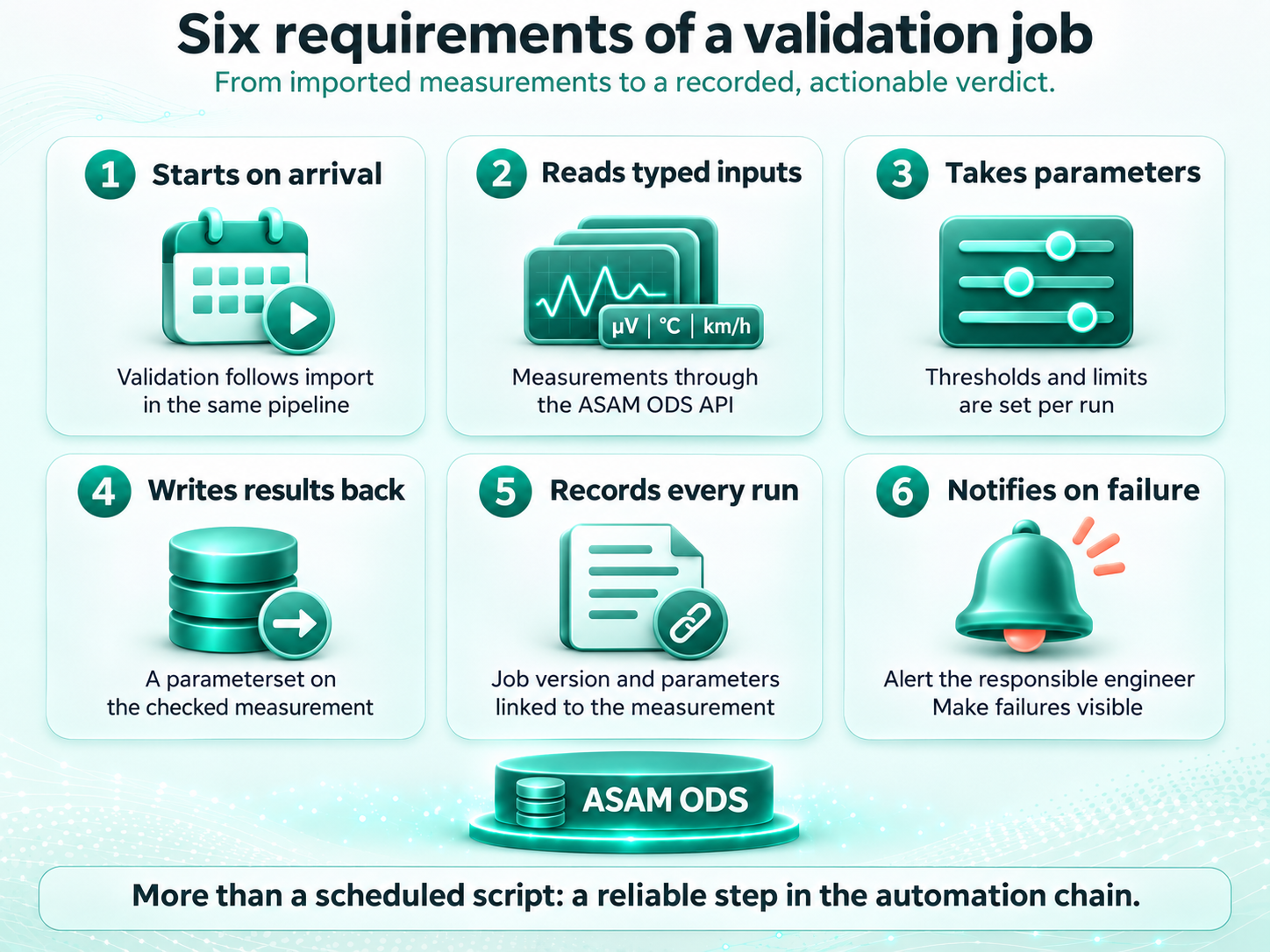
The Six Requirements / ASAM ODS Data Validation
A validation job must do six things. These six requirements for ASAM ODS data validation apply to any implementation, including one built in house. A job missing any one of them is not a step the ASAM ODS test data automation chain can rely on; it is a script that happens to run on a server.
Compliance needs one way of running every check. That means one version of each check, one record of each run, and one place to look for both. Together they let an organization show how any result was reached, whoever asks and whenever they ask. A check that runs as a job meets that condition, because one job replaces the personal copies, and every run names its job version and parameters and writes its record next to the measurement. A resolved special case enters the same way, as a new job version. A check that lives as personal copies on workstations cannot meet the condition, however careful each engineer is. Run as a job, the check becomes auditable.
Engineers need their own tools, and every estate already runs several. Import alone is a technology, with its own mapping, its own versions, and often its own pre-processing workflow in front of it. Add the one language the analysis team writes in, and the estate is already at two. Most are well past that. A decade of MATLAB signal processing, a younger team's Python notebooks and a data engineering group's Spark jobs accumulate the moment a second team, a second decade, or a second acquisition arrives. Forcing every check into one language would buy one way of running at the price of the tools the checks were built in.
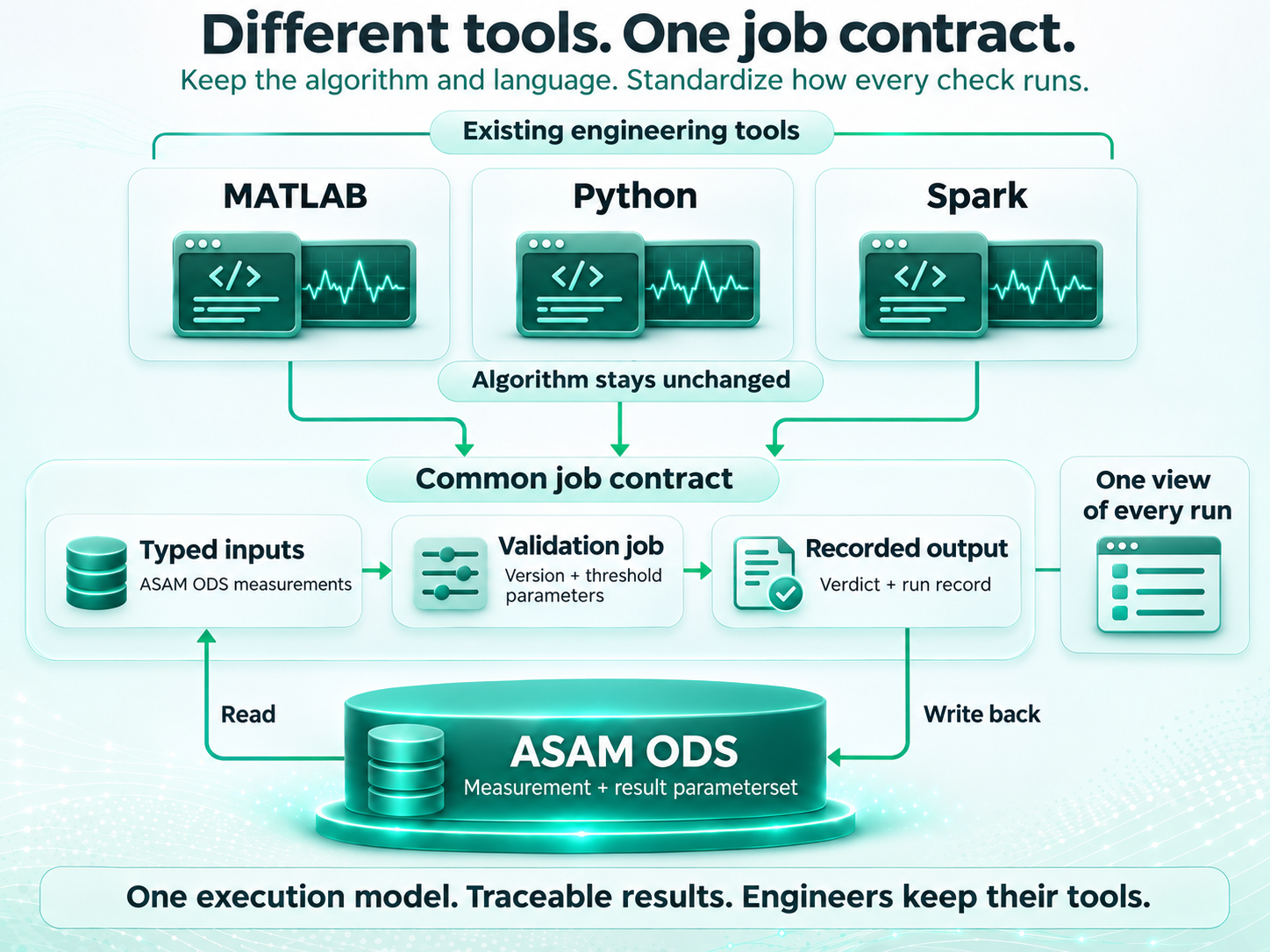
The Common Job Contract / ASAM ODS Data Validation
Both hold if the layer adapts, not the engineer. The algorithm stays as it is; the inputs and outputs are adapted to the stage contract, the fixed way a job hands data in and takes results out. A check that reads a channel, computes a value and compares it with a threshold keeps that logic unchanged, in the language it was written in. Its thresholds arrive as job parameters, and its verdict leaves as a parameterset written into ASAM ODS. The job description, the record and the place the result lands are the same for every language, so every language leaves the same record. One view over every tool keeps the engineers free and the chain compliant, at volumes no team could check by hand.
Automotive OEMs, test service providers, and testing laboratories run HighQSoft's ASAM ODS platform in production, across automotive, maritime, and battery testing.
HighQSoft has built on the ASAM ODS standard for more than 25 years, combining that history with production-proven automation and AI-assisted access. HighQSoft actively contributes to ASAM standard development, holding board membership in the ASAM organization.
HighQSoft GmbH
Black-und-Decker-Straße 17b
D-65510 Idstein
You are currently viewing a placeholder content from Facebook. To access the actual content, click the button below. Please note that doing so will share data with third-party providers.
More InformationYou are currently viewing a placeholder content from Instagram. To access the actual content, click the button below. Please note that doing so will share data with third-party providers.
More InformationYou need to load content from hCaptcha to submit the form. Please note that doing so will share data with third-party providers.
More InformationYou need to load content from reCAPTCHA to submit the form. Please note that doing so will share data with third-party providers.
More InformationYou are currently viewing a placeholder content from Turnstile. To access the actual content, click the button below. Please note that doing so will share data with third-party providers.
More InformationYou are currently viewing a placeholder content from X. To access the actual content, click the button below. Please note that doing so will share data with third-party providers.
More Information


