Test Data Automation | Page: 1 of 4 | Next: Page 2: ASAM ODS Data Validation as a Job
Test benches and vehicles produce measurement data around the clock. A durability rig writes through the night, a battery lab cycles cells in parallel for weeks, and a fleet of instrumented vehicles returns new files every day. Every stand records channels for every run, and more stands, sites and programs keep feeding one data layer. Nobody can look at that much data by hand, and in most organizations no team looks at all of it. What makes ASAM ODS test data automation workable is that most of the chain from bench to result already runs without anyone. The step that still needs a person is the exception, and it is the step where the whole chain waits.
This guide is about measurement data, not database records. Elsewhere, test data automation usually means provisioning masked or synthetic records into software test environments; here it means moving measured channels, with their units and context, from a test stand to a trustworthy result.
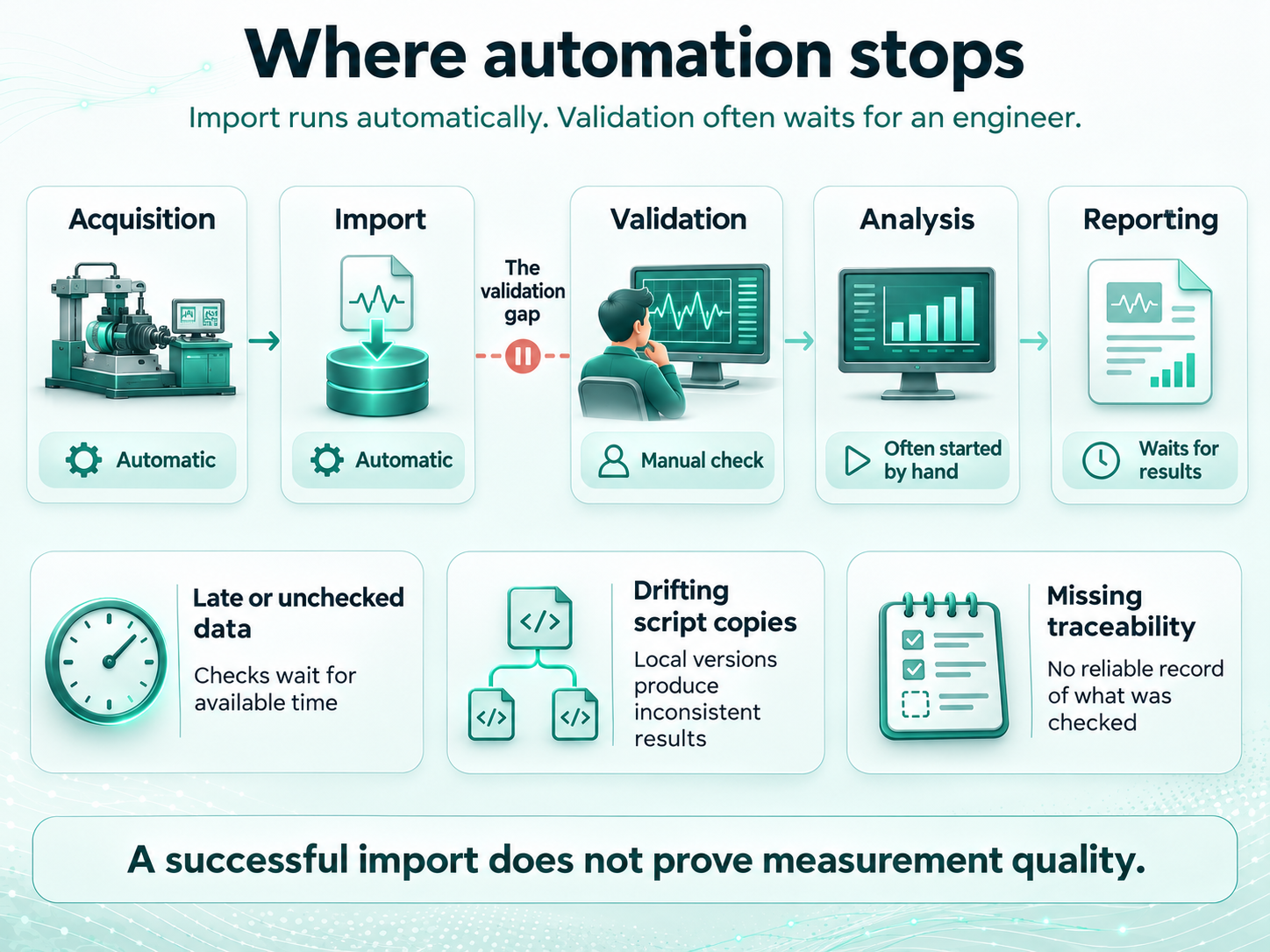
The Validation Gap / ASAM ODS Test Data Automation
The chain from test bench to report has five steps. Acquisition, import, validation, analysis, and reporting or release form a sequence every testing organization operates, whether it has ever drawn it as a chain or not. Test bench automation carries acquisition. From import onward, ASAM ODS and HighQSoft's software can carry the chain. Import makes each file fit the data model, so every measurement lands with its units and context in one standardized place. In ASAM ODS test data automation, the pattern holds across powertrain, battery, NVH, and durability testing alike.
Today the chain runs by itself only up to validation. Acquisition and import run alone; from file arrival to stored, contextualized measurement, the front of the chain runs without a hand on it. Import brings every file into the data model, but making a file fit the model is not the same as checking the measurement inside it. A file can import cleanly and still hold a stuck signal, a dropped channel or an implausible value. So a person opens a workstation, runs a check, and decides whether the data is good. Analysis is often started by hand after that, and reporting waits for both. Everything behind that decision moves at the pace of the person making it.
This guide is part of HighQSoft's series of definitive guides on engineering test data. Each guide answers one foundational question in depth, from the discipline of test data management to how AI fits into a governed measurement data platform. Start with the topic that matches your question.
Recording and import come with automation built in. Each is one task, done by one tool, and that tool usually ships with its automation. The test stand records every run as part of its own test bench automation. Nobody clicks import. Test bench automation, file arrival, or a schedule triggers import, and an import engine such as ModelMapper (MoMa) applies its import mapping, translating the source format into the organization's data model. How that mapping is built is covered in ASAM ODS and AI Part 02 on automated import. In most organizations, neither step had to be automated in house. The automation arrived with the tool, was configured once, and has been trusted since.
Checks and analyses come in many forms, each in its own tool. One team checks its runs with a Python script, another with a MATLAB function, and a third follows a written procedure step by step. Every test type needs its own plausibility rules, and every team writes them in the tool it knows best. There is no single tool to automate, so the logic stays where it was written. It lives on a workstation, owned by the engineer who wrote it, and runs when that engineer gets to it. The check itself is rarely hard to run unattended.
A manual break in an automated chain has three concrete costs, and none of them is anyone's fault. They are properties of the arrangement, not of the people in it, and they compound as test volume grows. Manual analysis doesn't scale; as test volumes grow, organizations need automated pipelines that run reliably, track every result, and integrate with existing tools.
Most data is checked late, or never. The import delivers a measurement minutes after the run ends, and the verdict arrives when an engineer next has time, hours or days later. A team that cannot keep up checks a sample and trusts the rest, so most of its data goes unchecked by default, not by policy. Every downstream consumer, from the analysis scripts to the program review, inherits the wait. Campaigns miss deadlines while their data sits imported, complete, and unexamined. The test stands wait too, because the slowest step in the chain that follows them caps their throughput. Until runs are declared good, no one can decide to re-run, release the rig or proceed, and expensive capacity sits idle.
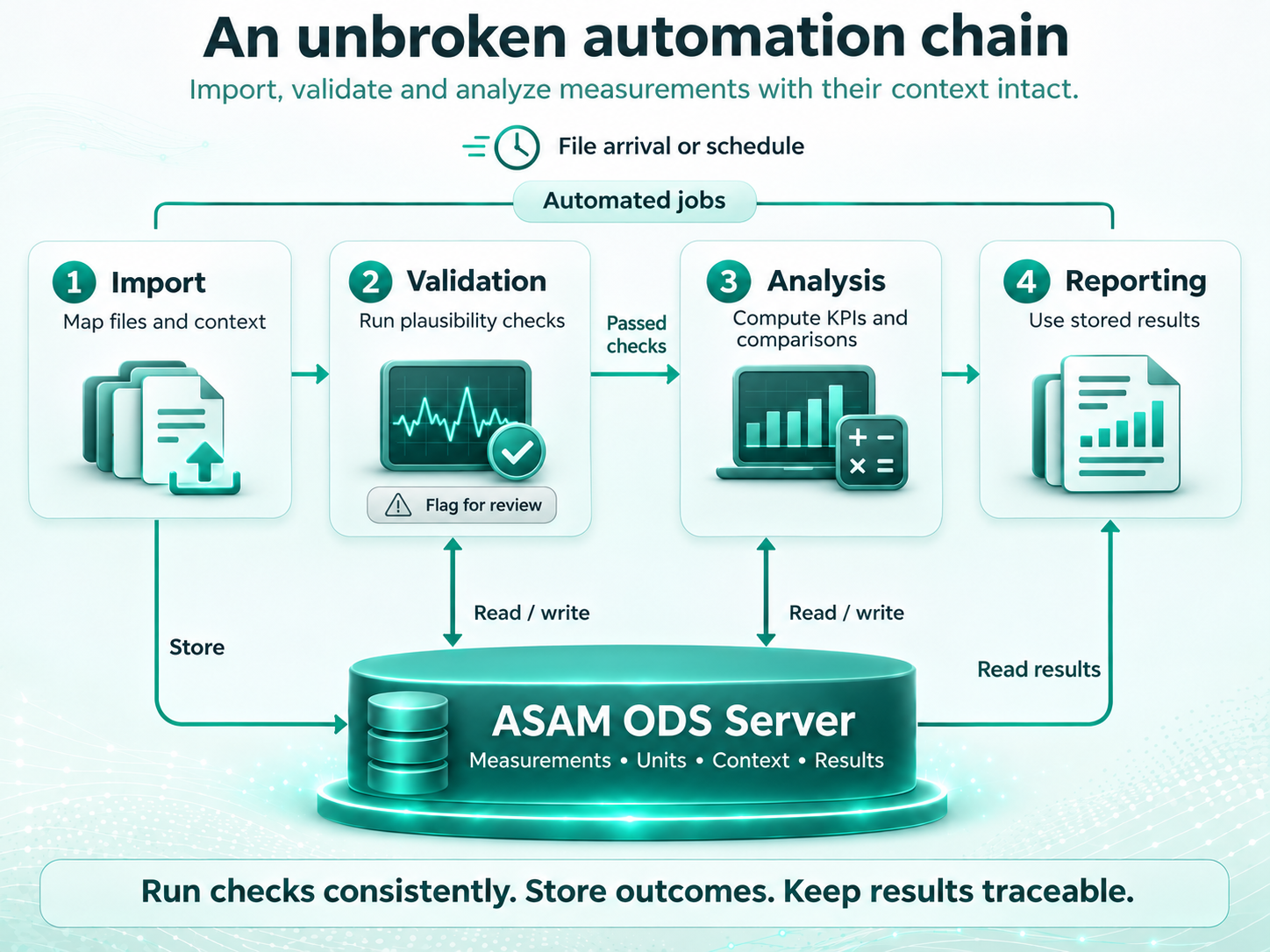
The Automated Chain / ASAM ODS Test Data Automation
Personal copies of the same check drift apart. When a check lives on workstations, every engineer who runs it holds a private copy, and an unversioned copy drifts. One engineer updates a threshold after a design change, another keeps the old value, and both are doing their jobs conscientiously. Anyone who has watched two engineers report different numbers from the same runs has seen this cost directly. The check is deterministic; its distribution is not.
Results do not compare, and nothing records the check. A run checked by one copy in March and a run checked by another copy in May carry the same verdict and mean different things. Numbers from two stands or two campaigns cannot be put side by side with confidence. Six months later, when someone questions a value, the answer lives in someone's memory of which script version they ran that week. The automated steps on either side record what they did; the manual step in the middle writes nothing. When an audit asks what was checked against which threshold, the manual step has no record to show.
None of these costs argues for working harder, because the step is already cheap to execute. They argue for moving the check to where the rest of the chain already runs. The fix is not a scheduler bolted onto a workstation. It is a layer that runs whatever language the estate's checks are written in and records what it did, as discussed on the next page.
Automotive OEMs, test service providers, and testing laboratories run HighQSoft's ASAM ODS platform in production, across automotive, maritime, and battery testing.
HighQSoft has built on the ASAM ODS standard for more than 25 years, combining that history with production-proven automation and AI-assisted access. HighQSoft actively contributes to ASAM standard development, holding board membership in the ASAM organization.
HighQSoft GmbH
Black-und-Decker-Straße 17b
D-65510 Idstein
You are currently viewing a placeholder content from Facebook. To access the actual content, click the button below. Please note that doing so will share data with third-party providers.
More InformationYou are currently viewing a placeholder content from Instagram. To access the actual content, click the button below. Please note that doing so will share data with third-party providers.
More InformationYou need to load content from hCaptcha to submit the form. Please note that doing so will share data with third-party providers.
More InformationYou need to load content from reCAPTCHA to submit the form. Please note that doing so will share data with third-party providers.
More InformationYou are currently viewing a placeholder content from Turnstile. To access the actual content, click the button below. Please note that doing so will share data with third-party providers.
More InformationYou are currently viewing a placeholder content from X. To access the actual content, click the button below. Please note that doing so will share data with third-party providers.
More Information


