What Is ASAM ODS? The Definitive Guide | Page: 3 of 4 | Previous: Page 2: ASAM ODS Architecture | Next: Page 4: ASAM ODS Implementation
HighQSoft provides ASAM ODS-based test data management solutions for automotive OEMs and engineering organizations worldwide. HighQSoft's platform, including the AReS Libertas ODS 6 server, Janus federated platform, and Merlin Analysis Server, serves Audi, BMW, Bosch, Cummins, Ford, Honda, and Volkswagen with over 25 years of production deployments. This guide explains what the ASAM ODS standard is, how it works, who uses it, and how organizations adopt it to manage engineering test data at enterprise scale.
ASAM ODS adoption spans the global automotive industry and is expanding into adjacent engineering sectors where physical testing produces large volumes of measurement data. The standard was initiated in the early 1990s by BMW, Daimler, and Porsche, and its adoption has grown steadily across Europe, North America, and Asia over three decades. Today, ASAM counts more than 420 member companies worldwide, and the organizations that use ASAM ODS in production include some of the largest and most demanding engineering operations in the world.
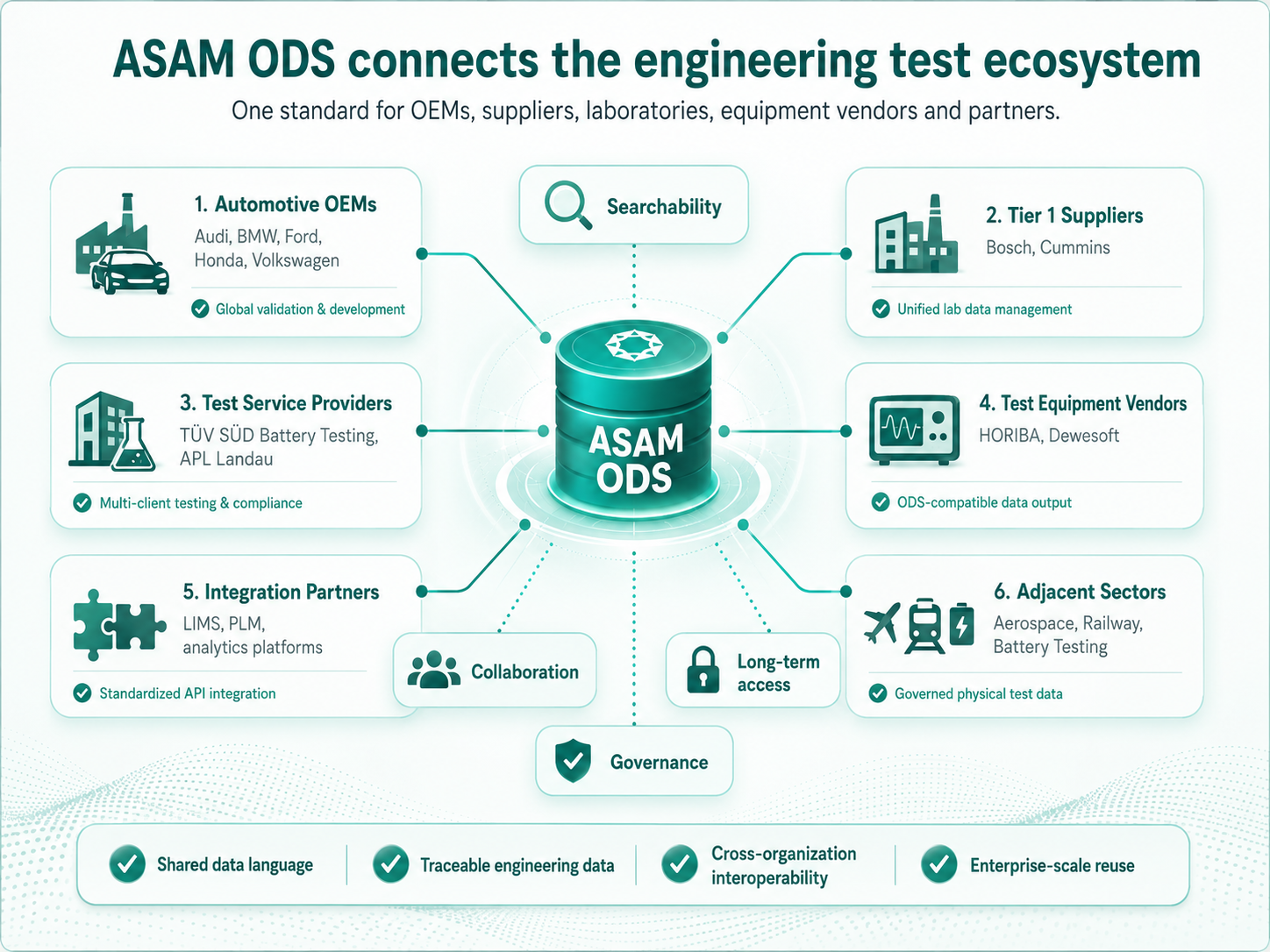
Who uses ASAM ODS?: ASAM ODS Adoption in the industry
Automotive OEMs form the core of ASAM ODS adoption. BMW was among the first organizations to deploy an ASAM ODS server, originally for wind tunnel testing data, and has expanded its use across multiple testing domains with production-scale automation powered by HighQSoft's Merlin Analysis Server and MATLAB Toolbox. Audi, Ford, Honda, Volkswagen, and other global manufacturers use ASAM ODS to manage the test data generated by their validation and development programs, which can span powertrain, NVH (noise, vibration, and harshness), vehicle safety, durability, emissions, and battery testing across dozens of facilities on multiple continents.
Tier 1 suppliers and engine manufacturers operate at comparable scale. Robert Bosch GmbH, one of the world's largest automotive suppliers, developed an internal platform called sLIM (standard lab information management) built on ASAM ODS to unify data management across more than 350 validation facilities. The sLIM deployment demonstrated that standardizing on ASAM ODS across a diverse portfolio of testing operations yields measurable benefits: standardized test documentation, improved searchability, increased test engineer productivity, and reduced hardware investment through centralized storage. Cummins, a global engine manufacturer, uses HighQSoft's MATLAB Toolbox for direct ASAM ODS integration in its analysis workflows.
Test service providers represent a growing segment of ASAM ODS adoption. Organizations like TÜV SÜD Battery Testing manage test data on behalf of multiple clients, which requires strict data sovereignty, access control, and traceability. TÜV SÜD Battery Testing operates HighQSoft's ASAMCommander, Merlin Analysis Server, and Catalog Editor in conjunction with dacore's TestLab Plus LIMS for a comprehensive laboratory management solution, demonstrating that ASAM ODS serves not only the organizations that produce test data but also those that manage it as a professional service.
Beyond automotive, ASAM ODS is finding adoption in sectors where the fundamental challenges of test data management are structurally similar. Aerospace and railway organizations use the ASAM ODS ATFX format for test data exchange. Battery testing for electric vehicles and energy storage systems represents a growing domain, driven by EU Battery Regulation requirements for traceability and long-term data retention. The common thread across all these sectors is the need to manage physically measured data at scale, with governance, searchability, and long-term accessibility, which is precisely the problem ASAM ODS was designed to solve.
Different types of organizations derive different value from ASAM ODS adoption. The following table maps organization types to their typical use cases and the primary benefits they realize from standardizing on ASAM ODS.
The breadth of this adoption map illustrates a key advantage of ASAM ODS over proprietary alternatives: the standard creates a common ground where OEMs, suppliers, service providers, and equipment vendors all speak the same data language. Data produced on an HORIBA test bench can flow into a Bosch ODS repository, be analyzed by an engineer at BMW using HighQSoft's MATLAB Toolbox, and archived for regulatory compliance using the same metadata model that the equipment vendor, the supplier, and the OEM all understand.
One of the persistent misconceptions about ASAM ODS is that it is exclusively suited for large, well-funded enterprise deployments. This perception is understandable given that the most visible ASAM ODS installations are at global automotive OEMs with thousands of engineers, but it does not reflect the actual scalability characteristics of the standard or its modern implementations. ASAM ODS scales in both directions: from a single test lab managing hundreds of measurements to a global organization managing petabytes across dozens of sites.
At the small end of the spectrum, a team of five to ten engineers can deploy an ASAM ODS server in a Docker container, connect their analysis tools through the standard API, and begin organizing their test data with structured metadata from day one. HighQSoft's ASAMCommander Lite, which is free production software rather than a limited trial, provides a web-based interface for exploring, searching, and bookmarking data.
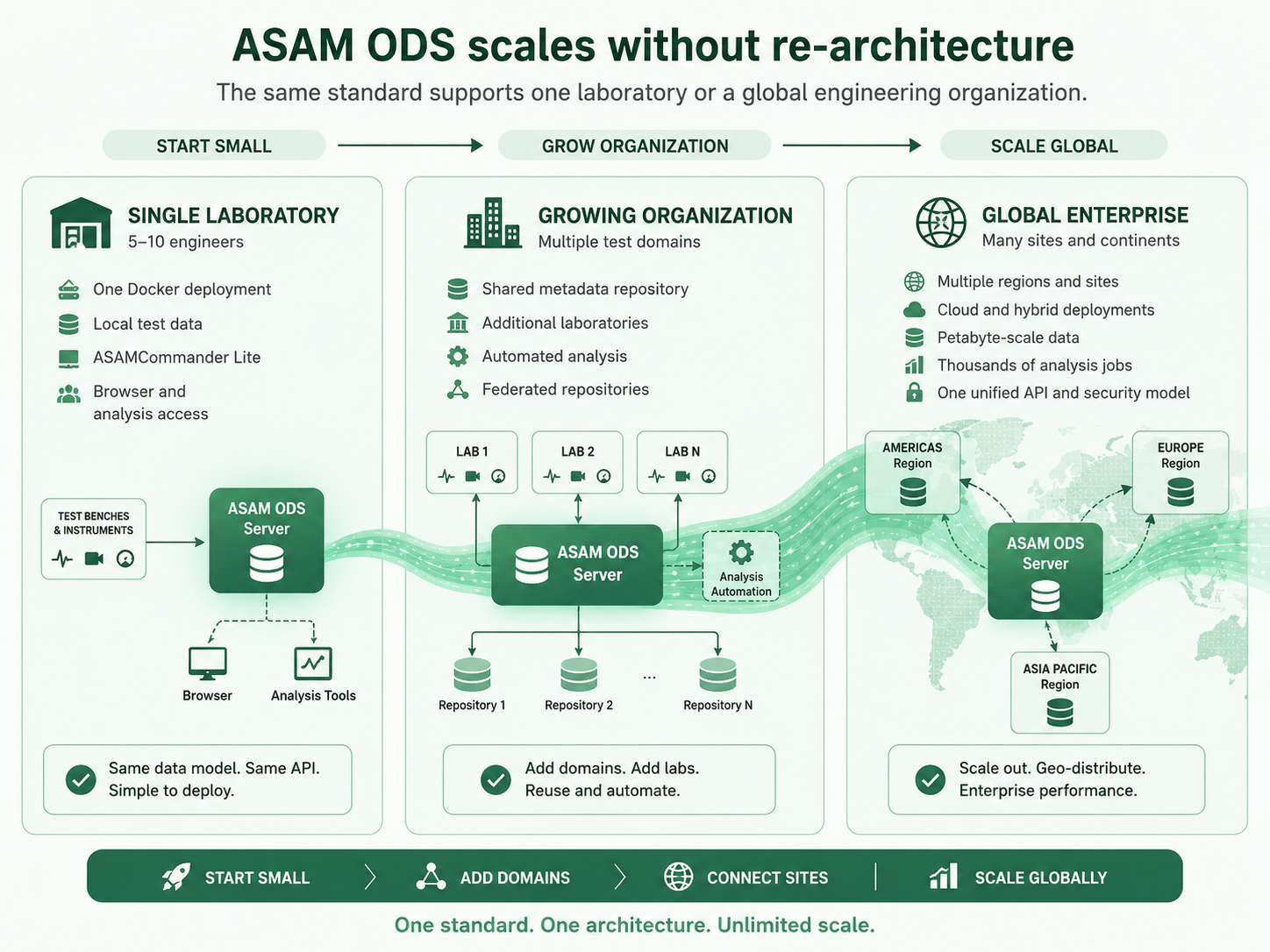
Who uses ASAM ODS?: ASAM ODS 6 scales in the cloud
The investment required to start is minimal, but the ASAM ODS data model and API are the same standard used by organizations a thousand times larger. This means the small deployment does not need to be re-architected when the team grows, when additional test domains are added, or when the organization decides to connect multiple labs.
At the enterprise end of the spectrum, ASAM ODS deployments manage databases exceeding 64 terabytes of metadata, run thousands of automated analysis jobs daily through HighQSoft's Merlin Analysis Server, and serve hundreds of concurrent users across multiple continents. The cloud-native architecture of ASAM ODS 6, with Docker containers and Kubernetes orchestration, enables elastic scaling: additional server instances spin up during peak analysis periods and release resources when demand subsides.
HighQSoft's Janus Platform extends ASAM ODS scalability further by federating data across multiple backends, including other ODS servers, MDF4 files, TDMS files, Parquet data lakes, and cloud object stores, without requiring data migration. An organization can connect a new test lab by deploying a Janus handler that points to the lab's existing storage, making its data queryable through the standard interface within days rather than months.
Global scale demands global infrastructure. HighQSoft's Janus Platform deploys on AWS, Google Cloud, Azure, and Alibaba Cloud, enabling organizations to run test data management infrastructure wherever their engineering teams and cloud analytics pipelines operate. A globally distributed engineering organization can place ASAM ODS servers close to the test labs that generate data, federate them through Janus, and give every engineer on every continent access to every measurement through a single API, regardless of where the data physically resides. For details on HighQSoft's cloud deployment options, see the cloud test data management overview.
The same scalability that connects data across sites also connects it to new ways of working. AI-assisted access to ASAM ODS data is available today through HighQSoft's MCP Server, which connects AI assistants like Claude and ChatGPT directly to measurement data for natural language queries, and through Claire, a web interface for AI-assisted data exploration. An engineer in a globally federated ASAM ODS environment can query test data in plain English rather than learning a query language, further lowering the barrier to productive use as the scale of the data grows.
For details on AI integration, see the AI analysis integration overview. ASAM ODS is not a standard frozen in the 1990s. It is actively evolving to meet the requirements of cloud infrastructure, AI-assisted engineering, and sovereign data exchange.
Engineers encountering ASAM standards often ask how ASAM ODS and ASAM MDF relate to each other. The answer is that the two standards are complementary: ASAM MDF (Measurement Data Format, current version MDF 4.3) is a binary file format for recording and exchanging measurement data, while ASAM ODS is a database standard for managing that data over its lifecycle. MDF4 files are one of the most common inputs to ASAM ODS systems, and the two standards are designed to work together.
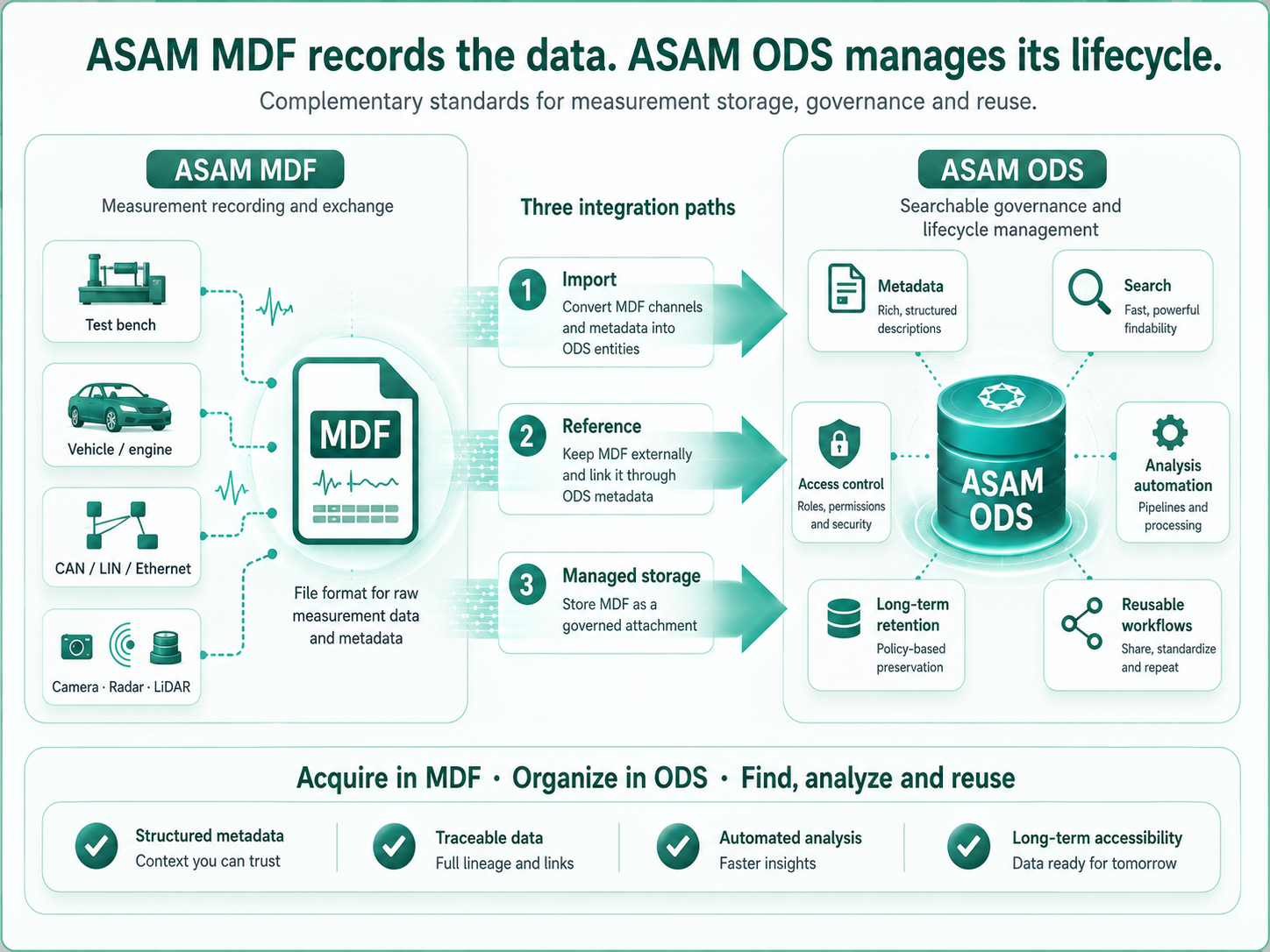
Who uses ASAM OD? ASAM ODS 6 in combination with ASAM MDF
ASAM MDF defines how measurement signals are stored in self-describing binary files. Each MDF4 file contains the channel definitions, conversion formulas, and metadata needed to decode and interpret its data. The format is optimized for data acquisition: test benches and data loggers write MDF4 files directly during measurement campaigns. MDF4 supports time-series signals, bus logging (CAN, LIN, FlexRay, Ethernet), ADAS sensor data (camera, radar, LiDAR), and classification results (histograms, matrices). The latest version, MDF 4.3 released in September 2025, adds support for dynamic data streams, SOME/IP service-oriented communication, and new compression algorithms. HighQSoft contributed to the development of MDF 4.3 alongside 20 other organizations including Audi, AVL, BMW, dSPACE, ETAS, and Mercedes-Benz.
The relationship between ASAM MDF and ASAM ODS follows three integration patterns. In the import pattern, MDF data is imported into an ASAM ODS database, converting channels and metadata into ODS entities for unified governance. In the reference pattern, ASAM ODS metadata references MDF files stored externally, preserving the original binary format while making the data searchable through the ODS API. In the storage pattern, MDF files are stored within ASAM ODS repositories as managed attachments.
The choice of integration pattern depends on the organization's requirements for data governance, storage efficiency, and query granularity. HighQSoft's Janus Platform supports all three patterns and can federate across MDF4 files on filesystems alongside data stored in ODS servers, presenting a unified view through the standard ASAM ODS API.
For organizations currently using MDF4 files as their primary data format, ASAM ODS provides the governance, searchability, and automation layer that file-based storage lacks. For more details on ASAM MDF, see the ASAM MDF4 overview on HighQSoft's website.
These are the questions teams ask most often about who uses ASAM ODS and where it fits.
ASAM ODS is used across the global automotive industry and adjacent engineering sectors. Automotive OEMs form the core of adoption, alongside Tier 1 suppliers, engine manufacturers, and test service providers. The standard was initiated in the early 1990s by BMW, Daimler, and Porsche, and ASAM now counts more than 420 member companies. HighQSoft provides ASAM ODS solutions with production deployments at Audi, BMW, Bosch, Cummins, Ford, Honda, and Volkswagen.
Beyond automotive, ASAM ODS is adopted in aerospace and railway, where organizations use the ATFx format for test data exchange, and in battery testing for electric vehicles and energy storage, driven by EU Battery Regulation requirements for traceability and long-term retention. The common thread is the need to manage physically measured data at scale with governance and long-term accessibility. HighQSoft supports these domains, including a battery testing reference at TÜV SÜD with its dacore LIMS integration partner.
Yes. ASAM ODS scales in both directions. A team of five to ten engineers can deploy a server in a Docker container and organize test data from day one, using the same data model and API as organizations a thousand times larger. At the enterprise end, deployments manage databases exceeding 64 terabytes of metadata and run thousands of automated analysis jobs daily. HighQSoft's ASAMCommander Lite is free production software for a small start, and the Janus platform federates data across sites and clouds as the deployment grows.
ASAM ODS and ASAM MDF are complementary. ASAM MDF (Measurement Data Format) is a binary file format for recording and exchanging measurement data, while ASAM ODS is a database standard for managing that data over its lifecycle. MDF4 files are one of the most common inputs to ASAM ODS systems, integrated through import, reference, or storage patterns. HighQSoft's Janus platform supports all three patterns and can federate across MDF4 files and ODS servers through the standard API.
Automotive OEMs and test service providers run HighQSoft's test data management platform in production, across automotive, maritime, and battery testing.
HighQSoft has provided ASAM ODS solutions for over 25 years, making HighQSoft one of the longest-serving specialists in engineering test data management. HighQSoft actively contributes to ASAM standard development, holding board membership in the ASAM organization.
HighQSoft GmbH
Black-und-Decker-Straße 17b
D-65510 Idstein
You are currently viewing a placeholder content from Facebook. To access the actual content, click the button below. Please note that doing so will share data with third-party providers.
More InformationYou are currently viewing a placeholder content from Instagram. To access the actual content, click the button below. Please note that doing so will share data with third-party providers.
More InformationYou need to load content from hCaptcha to submit the form. Please note that doing so will share data with third-party providers.
More InformationYou need to load content from reCAPTCHA to submit the form. Please note that doing so will share data with third-party providers.
More InformationYou are currently viewing a placeholder content from Turnstile. To access the actual content, click the button below. Please note that doing so will share data with third-party providers.
More InformationYou are currently viewing a placeholder content from X. To access the actual content, click the button below. Please note that doing so will share data with third-party providers.
More Information


