ASAMCommander is a modular web application for ASAM ODS–based test data management systems, providing engineers, analysts, and administrators with a customizable platform. It offers flexible data exploration and visualization, convenient ODS client, Matlab and Python access, and server-side analysis automation.
With ASAMCommander 25.2, we are releasing a major update to the AC-Mainframe and platform foundation. The new version focuses on corporate identity, embedded applications, user and group integration, and more predictable deployments. Platform owners and administrators can now brand ASAMCommander to match their environment, integrate more tightly with existing corporate authentication systems, such as OAuth, and operate external modules in a controlled and configurable manner.
In many ASAM ODS environments, ASAMCommander is more than just a client – it is the central entry point into a larger measurement data ecosystem. If branding, user management, or deployment patterns do not align with corporate standards, adoption suffers and operational overhead increases. The 25.2 mainframe update strengthens ASAMCommander as a platform, enabling it to be branded like any other enterprise application and supporting external applications through a consistent deployment and configuration model. This gives platform teams more control while reducing friction for end users.
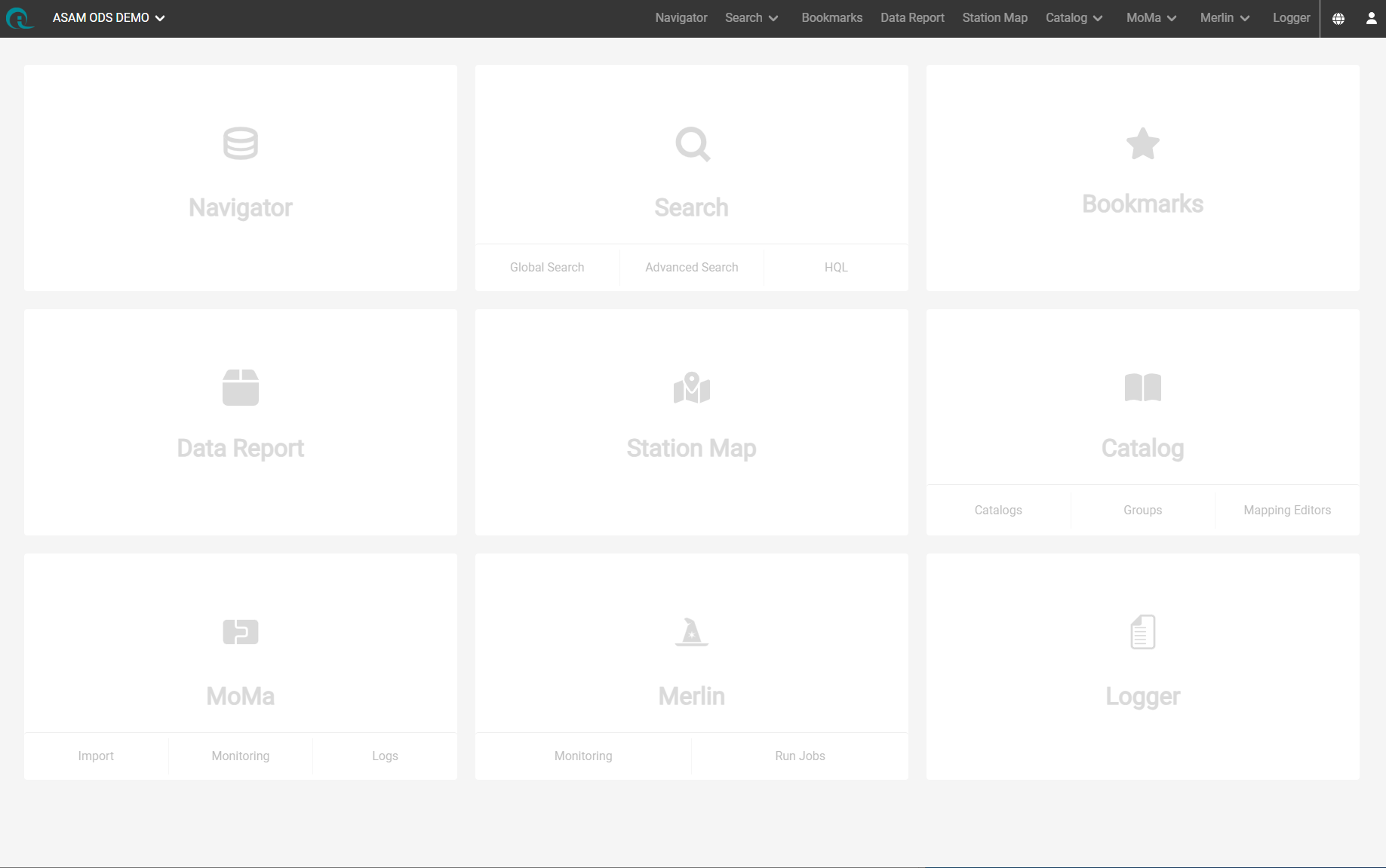
ASAMCommander including a selection of modules.
Mainframe - Corporate Identity and Embedded Applications
Catalogs Management - User & group integration
Deployment & external application integration
Logging and language polish
ASAMCommander 25.2 is available as an update for existing ASAMCommander installations. Customers can obtain the release via the usual delivery channels or on request. For installation support, upgrade planning, or questions about compatibility with your ASAM ODS environment, please contact your HighQSoft representative.
#ASAM #ODS #TestData #ASAMCOmmander #TDM #TestDataManagement #ASAMODS #HighQSoft
ASAM e.V. published a new version of the ASAM MDF standard - an ideal container file as input for ASAM ODS-based Test Data Management systems. ASAM MDF is a binary measurement file format that was first released in 1991. The two major versions in use are Version 3.x (2002-2009) and Version 4.x (2009-). The standard is backwards and forwards compatible (within a major version).
The following sections provide an overview of major MDF 4.3 features.
MDF is usually used to store data records of fixed size. For a sorted file (only one channel group per data group), this means one can jump to any desired record when reading. There is also support for storing signals of varying size e.g. strings. Each string may have a different length, so the variable length data is stored separately (e.g. in an SDBLOCK) and referenced from the channel block. Here, the fixed record stores an offset used to locate the string in the SDBLOCK.
MDF also supports arrays of fixed size (including multidimensional arrays) where each element is the same type of data. These strategies cannot handle more complex cases, where the number (or type) of signals changes with each record. This is dynamic data.
There are two main motivations for recording dynamic data:
MDF 4.3 introduces the DSBLOCK that can be used to mark a channel as containing dynamic data. In both cases, the raw data itself can be stored using the existing mechanisms for variable length data (VLSD, MLSD), fixed data or the new VLSC format.
The point of the DSBLOCK is to prevent readers supporting older versions of MDF from accessing and misinterpreting the dynamic data content, while referencing the description for MDF 4.3 compatible readers.
Features in Autonomous Driving or ADAS (advanced driver assistance system) are dependent on measurements of the environment made by sensors. A single item recorded by a sensor (e.g. a snapshot at a moment in time) is usually called a frame.
MDF extends the concept of a ‘frame’ to a sensor event: both the raw frame data and additional properties needed for interpretation (e.g. image dimensions).
MDF 4.x:
MDF 4.3
GNSS (Global Navigation Satellite System) is the generalisation of GPS. Previous versions of MDF didn’t provide a way to unambiguously recognize channels containing GNSS data. This made it difficult for readers to correctly interpret GNSS data (e.g. routes with latitude and longitude) in files written by third-party tools.
The new associated standard (Data Logging of Service Oriented Communication) is specifically designed to specify how SOME/IP is stored in MDF.
SOME/IP is a format for control messages sent over ethernet, used in AUTOSAR. It focuses on allowing clients to discover and subscribe to ‘services’ provided by a server. For example, this can be used to allow displays and telematics units to access data from cameras and other devices.
The standard defines names, tags and channel structures to allow a data logger to be able to store the raw content of the SOC data, with the important parts of the message structure ‘annotated’ in the form of MDF channels and metadata.
Most of the new dynamic data features can be stored in MDF using the existing mechanism for variable length signal data (VLSD) or maximum length signal data (MLSD).
However, VLSD has the disadvantage that the length of the variable signal data is always with the data itself, even after the file is sorted for efficient reading. This is often redundant when storing protocol data, since protocols often include the ‚count‘ as an additional channel.
VLSC allows the variable channel to reference a separate MDF channel that determines the count.
The changes are anticipated in the ASAM ODS 6.3 release which is scheduled for 2026. Please read our "What is ASAM MDF? The Definite Guide".
#ASAMMDF #TDM #TestDataManagement #ASAMODS #HighQSoft
HighQSoft GmbH
Black-und-Decker-Straße 17b
D-65510 Idstein
You are currently viewing a placeholder content from Facebook. To access the actual content, click the button below. Please note that doing so will share data with third-party providers.
More InformationYou are currently viewing a placeholder content from Instagram. To access the actual content, click the button below. Please note that doing so will share data with third-party providers.
More InformationYou need to load content from hCaptcha to submit the form. Please note that doing so will share data with third-party providers.
More InformationYou need to load content from reCAPTCHA to submit the form. Please note that doing so will share data with third-party providers.
More InformationYou are currently viewing a placeholder content from Turnstile. To access the actual content, click the button below. Please note that doing so will share data with third-party providers.
More InformationYou are currently viewing a placeholder content from X. To access the actual content, click the button below. Please note that doing so will share data with third-party providers.
More Information


