ASAMCommander is HighQSoft’s web-based, modular, standards-driven client for ASAM ODS test data. Test engineers browse, search, and visualize measurement data in the browser; administrators manage catalogs, monitor the system, and onboard data without installing anything on the desktop. Release 26.1.1 closes the first feature development cycle and delivers the largest module overhaul since the 25.2 platform update, the completely redesigned Merlin UI.
The headline of this release is the new Merlin UI, the ASAMCommander module for workflow automation with the Merlin Analysis Server. The previous Merlin module had grown apart from the rest of the product; it looked and behaved differently from Navigator, Catalog Editor, and the other modules. We redesigned it from scratch, starting with user interviews and interface prototypes, and integrated the result into this release. Merlin UI now shares the same interaction patterns as every other ASAMCommander module, so creating evaluations, launching jobs, and monitoring them feels like one product, not two.
The redesigned module covers the full evaluation workflow. Engineers browse available evaluations, provide parameters, and launch jobs; a system-wide monitoring view tracks running and queued jobs in real time; and the Blueprints Manager organizes reusable evaluation templates, including activating and deactivating blueprints so teams control exactly which evaluations are available for production use.
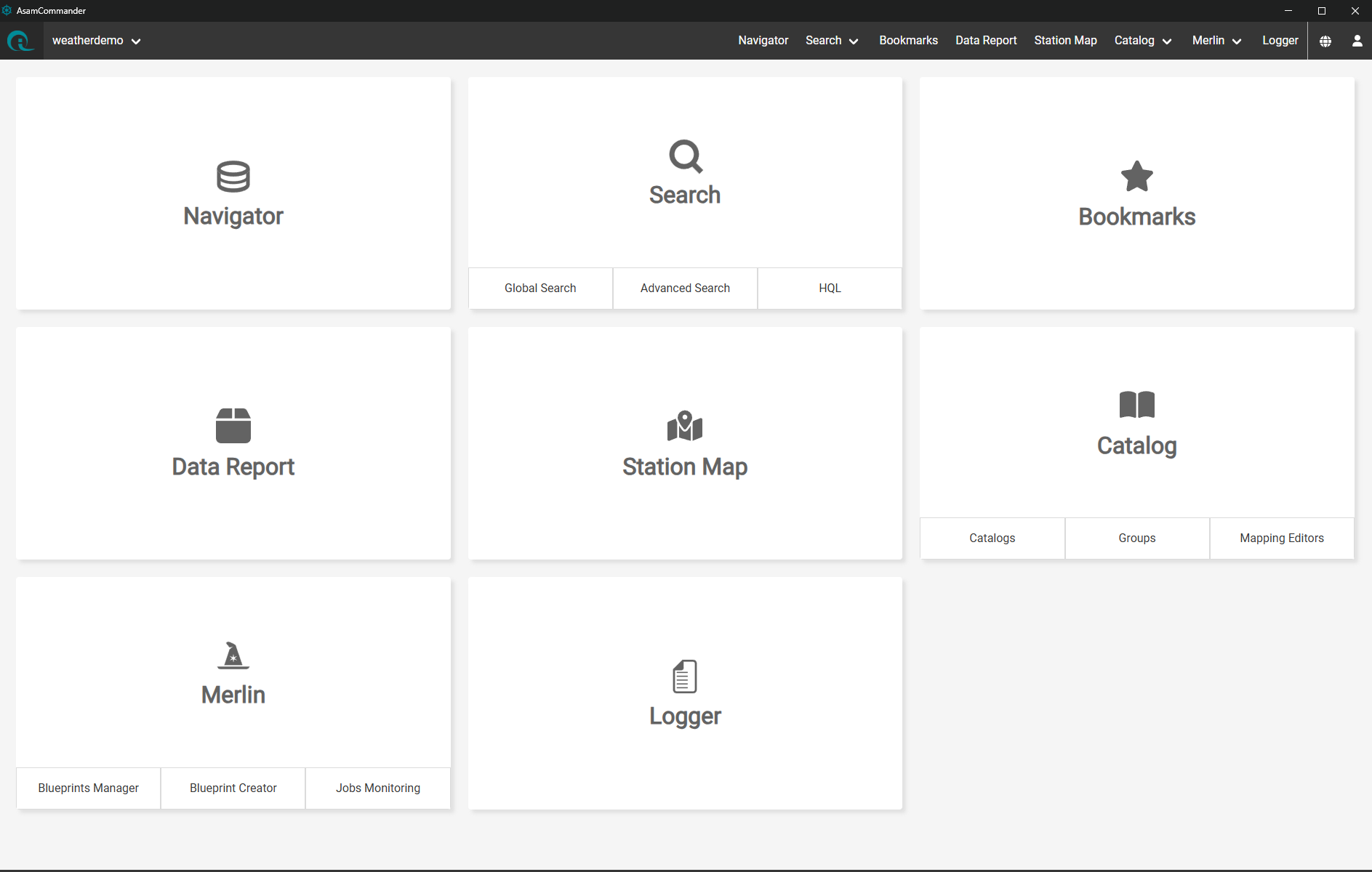
ASAMCommander ODS Client with Workflow Automation
Beyond the Merlin UI redesign, 26.1.1 improves nearly every module of the product.
ASAMCommander 26.1.1 also introduces the AC Professional Distribution, a verified bundle in which the mainframe and all module versions are tested to work together. It ships as a single Docker image and as a ZIP/TAR archive, available from the HighQSoft public Harbor registry and our download platform. Contact your HighQSoft representative to plan the update, or reach us through highqsoft.com.
*#ASAM #ODS #ASAMCommander #Merlin #TestData #TestDataManagement #HighQSoft*
Following the release of Anthropic's newest Claude model, Fable 5, HighQSoft ran a focused experiment. Could an AI agent derive a reusable skill that creates ASAM ODS dashboards on measured data?
The specification was about 20 lines long and contained mostly boundary conditions, namely Streamlit as the dashboard framework, pyHQL for data access, and the HighQSoft MCP Server for ASAM ODS as the discovery layer. The dashboards themselves were a free pass.
The directions were to discover the database, create five dashboards, keep the skill generic by representation type (graph, geo, table), offer features such as sliders and filters based on the discovered application model, and reinforce lessons learned from each step.
The agent ran for 25 minutes with one manual feedback loop. The result on HighQSoft's weather demonstration database was five working dashboards, a Channel Explorer, a Climate Map, Database Statistics, Last Data Imports, and a Measurement Channel Comparison. Every dashboard runs on live HQL queries against the ODS server. No data was exported, copied, or staged.
Two components made the result possible.
The five dashboards are the visible output, but the actual result is the skill that now builds the next ones. Because the skill works from model discovery rather than hard-coded names, it transfers to any ASAM ODS application model. Test engineers describe the view they want in plain language, and the skill composes, validates, and ships a live dashboard from there.
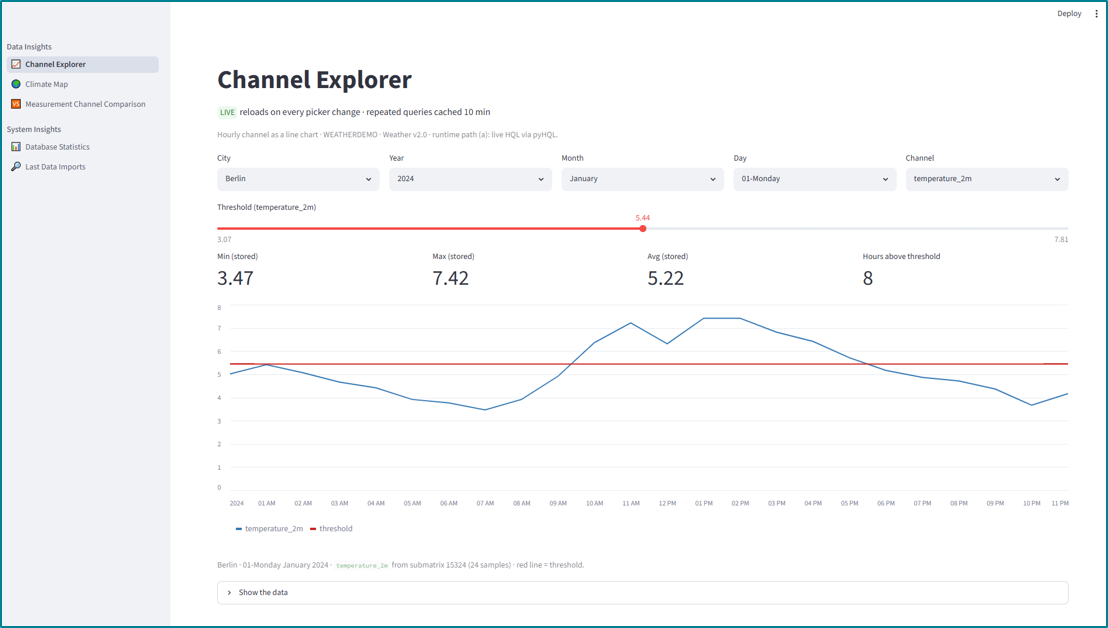
ASAM ODS Dashboards - Channel Explorer (Streamlit)
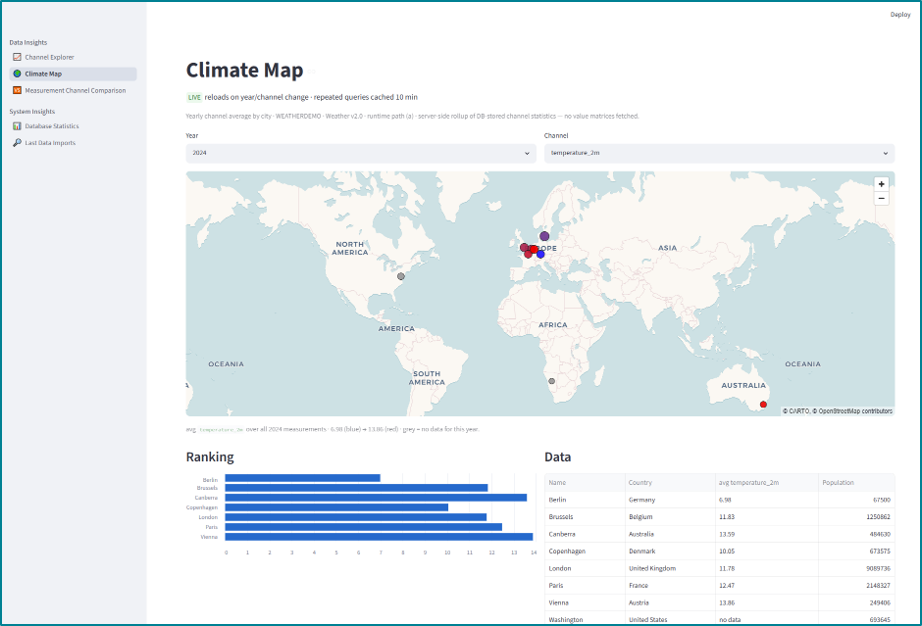
ASAM ODS Dashboards - Climate Map (Streamlit)
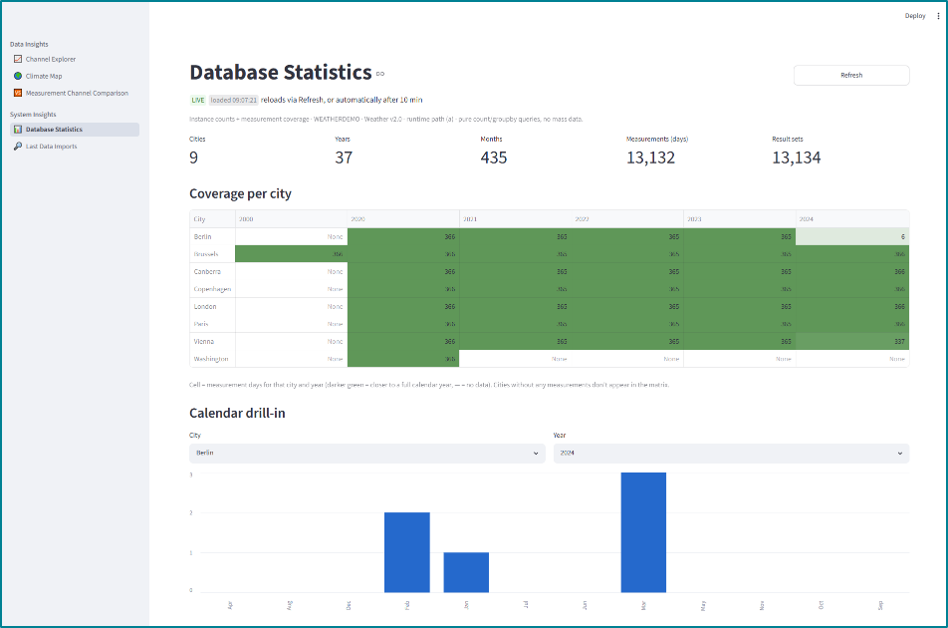
ASAM ODS Dashboards - Database Statistics (Streamlit)

ASAM ODS Dashboards - Last Data Imports (Streamlit)
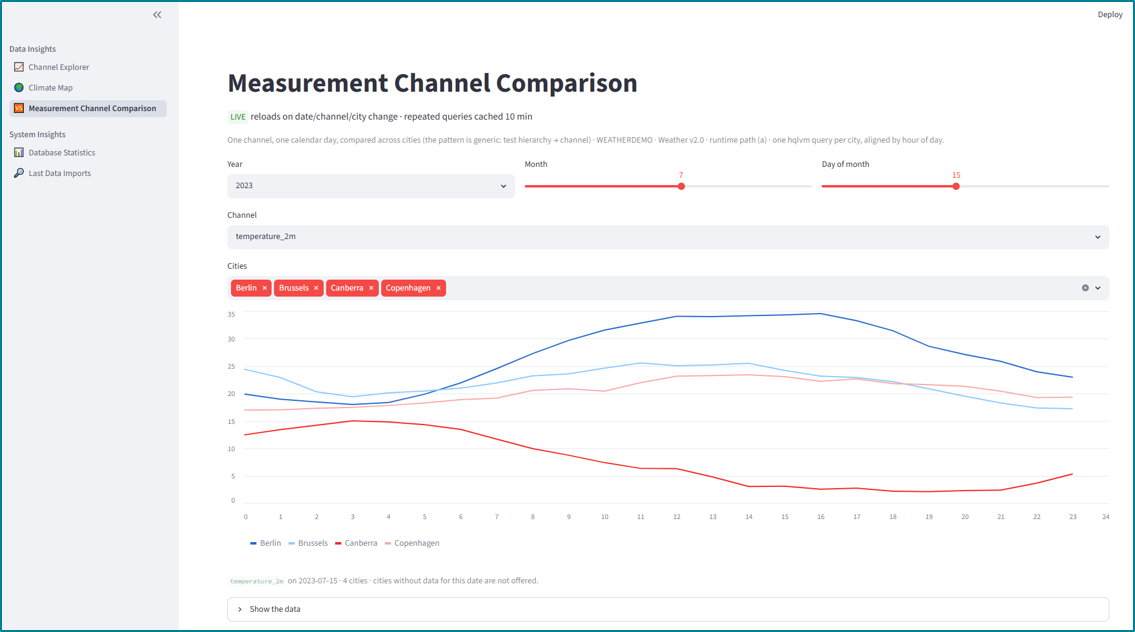
ASAM ODS Dashboards - Measurement Channel Comparison (Streamlit)
#ASAM #ODS #AI #MCP #HQL #Streamlit #TestData #HighQSoft
HighQSoft has published a new short story, When Data Spaces Come for Test Data, Standardization Connects. The piece argues that data spaces strengthen, rather than weaken, the case for ASAM ODS. A file-based stack works as long as the system stays local. The moment data crosses an organizational boundary, the standard is what makes that boundary tractable.
The article belongs to HighQSoft's standardization series, which dedicates one short story to each of the five test data management pillars. This installment is the Connected pillar, where the ASAM ODS Standard reaches across organizations into data spaces.
A data space connector solves transport, not meaning. A file dropped into a connector arrives at the consumer as a blob to be re-interpreted from filenames and folders. The Eclipse Dataspace Connector and its Tractus-X derivative move bytes between provider and consumer; they do not move the contents of those bytes. Without a shared schema, the consumer rebuilds the producer's interpretation by hand, every time, which is exactly the delegated re-import that standardized test data management was meant to avoid.
The story sets out five properties that decide whether a cross-organization exchange becomes useful infrastructure or stays a transport layer with a contract attached. These include schema-to-schema exchange, sub-file asset granularity, calculated results as practical assets, contracted reports and exports, and catalogs with lineage that make exchange auditable and reusable. The closest production parallel today is the Catena-X Product Carbon Footprint exchange, where values flow and aggregate across the supply chain only because a rulebook standardizes how each participant interprets each value.
The article shows two clean ways to connect a HighQSoft installation to a data space, both part of the production architecture today. Janus, the federation layer, treats a connector as one more handler and presents incoming assets as a unified ASAM ODS view for the consumer. ASAMCommander's internal NXServices, orchestrated by Merlin, publish measurements, KPIs, results, and reports to the data space as a provider. Both directions have been demonstrated with real connectors in the GAIA-X 4 KI and RepliCar research projects, including cross-cloud exchanges between separate clouds.
Read the full short story at When Data Spaces Come for Test Data, Standardization Connects.
*#ASAM #ODS #TestData #DataSpaces #GAIAX #DataSovereignty #HighQSoft*
The article then shows how HighQSoft's stack already plugs AI into the standard. The MCP Server connects Claude and ChatGPT to ASAM ODS through HQL. Merlin AI extends the same pattern to analysis pipeline composition. MoMa AI, from the AEOPT research project, generates importer mappings from sample data so a new measurement source becomes queryable in hours.
*#ASAM #ODS #AI #TestData #HQL #MCP #HighQSoft*
pyHQL (ASAM ODS Toolbox for Python) enables analysts and engineers to utilize the HighQSoft Query Language (HQL) to work directly with ASAM ODS data from Python, providing typed results, mass-data access with units, transactions, and file streaming for analysis, scripts, and dashboards.
HighQSoft is introducing pyHQL, a lightweight Python library that connects to the HQL WEB Service and, through it, to any ASAM ODS server in your infrastructure. You use familiar HQL commands to query metadata and measurement data. pyHQL maps ASAM ODS datatypes to convenient Python objects, allowing you to analyze them immediately.
pyHQL eliminates the effort of crafting low-level REST calls and interpreting ASAM ODS datatypes by providing a ready-to-use library—so teams can spend time analyzing data and focusing on insights rather than integration work.

Python Library for ASAM ODS: The HQL Web Service delivers product-based stability and all HQL comfort to the Python end-user.
For End-users
Query information easily — Use the same HQL queries you already know to retrieve any information from ASAM ODS servers - with all the comfort you'd expect!
Work natively in Python & Data Frames — Stay in your comfort zone with Python, Pandas, and friends.
For Analysts & Data Scientists
For Administrators
from highqsoft.pyHQL.HQL import HQL ASAM ODSURI="hql://admin:admin@localhost:xxxx?licenseserver=xxxx@licenseserver"
hqlURI="http://192.168.xxx.xx:xxx"
hql = HQL(hqlURI, ASAM ODSURI)
>>> result = hql.query("hql id, name from aotest")
>>> print(result)
---------------------------------------------------------
| Station 0.056 seconds to fetch 83 rows with 2 columns |
| id | name |
---------------------------------------------------------
| 26 | Alsfeld |
| 5 | Neuruppin-Alt Ruppin |
| 45 | Anklam |
...
| 81 | Veilsdorf |
| 82 | Oberhaching-Laufzorn |
| 83 | Waltrop-Abdinghof |
| 61 | Helmstedt-Emmerstedt |
---------------------------------------------------------
83 rows selected
---------------------------------------------------------
Query time: 0.056 seconds
Printer time: 0.001 seconds
Execution time: 0.057 seconds
pyHQL is available now as a ZIP for pip install from the HighQSoft download page. The manual includes installation steps, connection examples, and a quick tour of queries, mass data access, transactions, and file transfer.
#ASAM #ODS #TestData #Merlin #Python #pyHQL #TDM #TestDataManagement #ASAMODS #HighQSoft
Innovative approach to integrating real-time data
Simulated validation of sensors using reference sensors
In the latest conference proceedings published by ASAM e.V. (Association for Standardization of Automation and Measuring Systems), Dr. Frank Hantschel (RA Consulting) and Dr. Ralf Nörenberg (HighQSoft) report on the technical advantages of integrating automotive standards into a reference system, using the RepliCar joint project as an example. They also demonstrate why this can lead to a sustainable reduction in development costs.
The aim of the BMWK-funded project is to investigate new approaches to reference sensor technology for high-precision sensor validation for automated driving and to obtain a precise, reliable representation of reality as a reference value for validation. The safe perception of the environment and the accurate localization of one's own perspective within the environment are two crucial prerequisites for the virtual validation and homologation of automated vehicles.
To this end, the partners in the RepliCar research project are currently developing a suitable reference system. To enable the near-real-time, smooth, and loss-free exchange of real-time data in this system, HighQSoft GmbH and RA Consulting are jointly designing a forward-looking end-to-end cloud architecture for telematics applications. RA Consulting's challenging tasks in this project include
The long-term goal is to develop a digital twin that is compatible with vehicle electronics. We are pleased to make this exciting article available to you free of charge with the kind permission of ASAM e.V.: “The research project RepliCar – Coverage and interoperability of ASAM standards in an endpoint-2-edge-2-edge-cloud application”


The ASAM:GUIDE is a comprehensive reference to ASAM standards, ASAM technologies, ASAM members, and ASAM-compliant products. This guide is designed to be your go-to resource for understanding how ASAM supports the future of vehicle development and testing.
The guide provides an overview of ASAM’s complete standards portfolio and shares insights into how these standards interconnect and complement each other. The numerous application stories provided by our members give you a great impression of what can be achieved if you adopt standards and if you actively engage in their development. [by ASAM e.V.]
#ASAM #ASAM_GUIDE #standardization #collaboration #automotive #mobility #standards #HighQSoft #RAConsulting #RepliCar
ASAM e.V. published a new version of the ASAM MDF standard - an ideal container file as input for ASAM ODS-based Test Data Management systems. ASAM MDF is a binary measurement file format that was first released in 1991. The two major versions in use are Version 3.x (2002-2009) and Version 4.x (2009-). The standard is backwards and forwards compatible (within a major version).
The following sections provide an overview of major MDF 4.3 features.
MDF is usually used to store data records of fixed size. For a sorted file (only one channel group per data group), this means one can jump to any desired record when reading. There is also support for storing signals of varying size e.g. strings. Each string may have a different length, so the variable length data is stored separately (e.g. in an SDBLOCK) and referenced from the channel block. Here, the fixed record stores an offset used to locate the string in the SDBLOCK.
MDF also supports arrays of fixed size (including multidimensional arrays) where each element is the same type of data. These strategies cannot handle more complex cases, where the number (or type) of signals changes with each record. This is dynamic data.
There are two main motivations for recording dynamic data:
MDF 4.3 introduces the DSBLOCK that can be used to mark a channel as containing dynamic data. In both cases, the raw data itself can be stored using the existing mechanisms for variable length data (VLSD, MLSD), fixed data or the new VLSC format.
The point of the DSBLOCK is to prevent readers supporting older versions of MDF from accessing and misinterpreting the dynamic data content, while referencing the description for MDF 4.3 compatible readers.
Features in Autonomous Driving or ADAS (advanced driver assistance system) are dependent on measurements of the environment made by sensors. A single item recorded by a sensor (e.g. a snapshot at a moment in time) is usually called a frame.
MDF extends the concept of a ‘frame’ to a sensor event: both the raw frame data and additional properties needed for interpretation (e.g. image dimensions).
MDF 4.x:
MDF 4.3
GNSS (Global Navigation Satellite System) is the generalisation of GPS. Previous versions of MDF didn’t provide a way to unambiguously recognize channels containing GNSS data. This made it difficult for readers to correctly interpret GNSS data (e.g. routes with latitude and longitude) in files written by third-party tools.
The new associated standard (Data Logging of Service Oriented Communication) is specifically designed to specify how SOME/IP is stored in MDF.
SOME/IP is a format for control messages sent over ethernet, used in AUTOSAR. It focuses on allowing clients to discover and subscribe to ‘services’ provided by a server. For example, this can be used to allow displays and telematics units to access data from cameras and other devices.
The standard defines names, tags and channel structures to allow a data logger to be able to store the raw content of the SOC data, with the important parts of the message structure ‘annotated’ in the form of MDF channels and metadata.
Most of the new dynamic data features can be stored in MDF using the existing mechanism for variable length signal data (VLSD) or maximum length signal data (MLSD).
However, VLSD has the disadvantage that the length of the variable signal data is always with the data itself, even after the file is sorted for efficient reading. This is often redundant when storing protocol data, since protocols often include the ‚count‘ as an additional channel.
VLSC allows the variable channel to reference a separate MDF channel that determines the count.
The changes are anticipated in the ASAM ODS 6.3 release which is scheduled for 2026. Please read our "What is ASAM MDF? The Definite Guide".
#ASAMMDF #TDM #TestDataManagement #ASAMODS #HighQSoft
Today, we released a number of improvements for our products
The release includes several enhancements for managing catalogs in ASAM ODS (Physical Dimensions, Units, Quantities, and groups). The Catalog Editor provides comprehensive CRUD (Create, Read, Update, Delete) operations and additional features like transaction control, drag and drop functionality, and support for managing catalog elements and their instances.
This update allows creating transactions outside of HQL and requesting HQL to use them. This lifts the limitation of only one transaction per ASAM ODS session.
A new Validation Job Pipeline runs custom Python scripts on imported data if certain criteria are met. The scripts can generate new parameters or measurements based on the data.
Introduces a Job Pipeline for checking newly imported measurements against filter criteria stored in the ASAM ODS database. The pipeline stages include applying filter criteria, copying processing results, and triggering validation.
Implements a git storage for loading remote stage functions for Job Pipelines making it easier to manage and update scripts.
All updates enhance the functionality and flexibility of the Test Data Management Ecosystem providing robust tools for data validation, transaction handling, and catalog management.
#HighQSoft #Release #HQL #SoftwareUpdate #ASAMCommander #ASAMODS
Test Data Management can be a headache. Multiple proprietary formats, incompatible data structures, and a never-ending stream of new information can make it difficult, if not impossible, to turn raw data into actionable knowledge.
At HighQSoft, we specialize in wrangling your measurement data into something you can use today and in the future. We offer multiple products and solutions to help you organize and manage data, regardless of volume and format.
Our ASAMCommander is a test data management application based on the ASAM ODS standard (https://www.asam.net/standards/detail/ods/). As a modular web application, it comprises loosely coupled, functional units called modules that form a customizable experience for end-users, system and data administrators, or data analysts.
The basic version of ASAMCommander is an out-of-the-box application that provides all end-user use cases for data exploration (navigation, search, visualization), expert tool integration (e.g., AVL Concerto, Mathworks Matlab, NI DIAdem), and data exports (ASAM ATFx, CSV, ASAM MDF).
The Enterprise Edition of ASAMCommander is suited for Global Test Data Management solutions based on the AReS Libertas ODS6 Platform. System administration features include system logging, data lineage, and data retention. Our Merlin Analysis Framework provides all features for complete automation of analysis pipelines. ASAMCommander Enterprise allows customization, and new modules, features, and workflows are easy to add or integrate.
The ASAMCommander release 24.2 is now available at our download portal and includes:
AC-Mainframe
AC-Navigator
AC-Logger
General Features
The release contains various enhancements and updates for AC-MoMa, AC-Bookmarks, AC-Search, and AC-Merlin.
ASAMCommander works with any data model (ISO Safety, ASAM NVH, custom models), all domains (battery, powertrain, vehicle, ...), and any ASAM ODS server (AReS ODS Server, AVL Santorin).
#HighQSoft #TestDataManagement #MeasuredDataManagement #ASAMODS #ASAM #Release #Innovation
Libertas 24.1.3 brings a series of significant improvements and new features designed to enhance your experience. Here are the highlights of this release:
application/octet-stream content type, following industry recommendations for better compatibility.
These enhancements and fixes are part of our ongoing commitment to improving Libertas, making it more robust, secure, and user-friendly.
#HighQSoft #SoftwareUpdate #Libertas #Innovation
HighQSoft GmbH
Black-und-Decker-Straße 17b
D-65510 Idstein
You are currently viewing a placeholder content from Facebook. To access the actual content, click the button below. Please note that doing so will share data with third-party providers.
More InformationYou are currently viewing a placeholder content from Instagram. To access the actual content, click the button below. Please note that doing so will share data with third-party providers.
More InformationYou need to load content from hCaptcha to submit the form. Please note that doing so will share data with third-party providers.
More InformationYou need to load content from reCAPTCHA to submit the form. Please note that doing so will share data with third-party providers.
More InformationYou are currently viewing a placeholder content from Turnstile. To access the actual content, click the button below. Please note that doing so will share data with third-party providers.
More InformationYou are currently viewing a placeholder content from X. To access the actual content, click the button below. Please note that doing so will share data with third-party providers.
More Information


